Showing posts with label Anthony Trollope. Show all posts

Thursday, 12 April 2012

The Cornhill Magazine


In early 1975 I travelled from Bath by train to London for a farewell drink with colleagues in the Civil Service at the Empress State Building in Earl's Court (I was changing career direction and we were about to leave Somerset for the coast of Anglesey). After the farewells had all been made, there was time before the evening train to hasten down the Earl's Court Road to a bookshop I had visited several times before. This, I think, was called Scudamore Books, now long gone like so many in busy shopping streets.


At the back of the shop I noted a pile of stout octavo, mainly leather bound books; these were various volumes of the 'Cornhill Magazine' dating from the 1860s to the 1880s.


Browsing in them I noted works by Thackeray, Trollope, Thomas Hardy and others in serial form, together with fine illustrations by artists such as Millais and George du Maurier. So, what to do? There were 14 volumes in all; leaving some behind was, of course, unthinkable. This was clearly a moment made for the dedicated book buyer, so negotiations began and we settled on 50p a volume, making a total price of £7. What followed was a nightmare journey to Paddington, by foot and tube (I think it was also raining) carrying four large bags with a total book weight of 16kg, then train to Bath, and finally home to Midsomer Norton with the handles of the bags by now pretty much welded into my fingers.

It was then that serious browsing began to find out what further treasures lay within. The volumes I had were not a continuous run, but there were some small runs within the set and some complete novels, such as "Wives and Daughters", by Mrs Gaskell, "The hand of Ethelberta" by Thomas Hardy and "The Small House at Allington" by Trollope. The volumes each comprised 6 monthly parts and typically a novel would span two or three voilumes.

Since that initial puchase we have added more volumes to fill the gaps and we now have a run of the first 18 volumes (i.e. 9 years) and a further 6 volumes, the final one being Jan-Jun 1883.

The Cornhill Magazine was founded in 1860 under the editorship of Thackeray and, amazingly, continued publication until 1975, although its best years were in the early part of its life. Its publishers were Smith, Elder, the publishers of Charlotte Bronte and John Ruskin and a later editor was Leslie Stephen, father of Virginia (Woolf) and Vanessa (Bell). The magazine was named after its place of publication in the heart of London's publishing district. The 1860s were, perhaps the highwater mark for literary magazines and the Cornhill competed for circulation with Charles Dickens' "All the Year Round" (founded in 1859) but was a much more attractive publication, with its fine illustrations.

The first issue commenced publication of one of Trollope's finest novels "Framley Parsonage", illustrated by J E Millais.


The first few months also featured Thackeray's "Roundabout Papers" and George Macdonald's supernatural story "The Portent", illustrated by W J Linton.


Another highlight in Volume 1 is the fragment of Charlotte Bronte's last novel "Emma", published here for the first time, with a note on the author by Thackeray.

Volume 2 saw the commencement of publication of John Ruskin's "Unto This Last".


This turned out to be too radical for the conservative owner George Smith and the Cornhill ceased publication of the work after four parts. In book form, though, it went on to be one of Ruskin's bestselling and most enduring books and a great influence on socialist philosophy.

1862 saw George Eliot's "Romola" commenced, together with Trollope's "The Small House at Allington", illustrated again by J E Millais.


The 1860s are justly renowned for the large number of classics of English literature published in this decade and also for the excellence of the artists who supplied the illustrations for these novels, the Cornhill containing some of the best work of these artists. Browsing in the first 18 volumes (covering the 1860s) I find in addition to the novels mentioned above:

"Cousin Phyllis" and "Wives and Daughters" by Mrs Gaskell, these were beautifully illustrated by George du Maurier.


The latter novel remained unfinished at the time of the author's death, which is again noted by the editor, with an indication of how the novel may have finished.

"Armadale", one of Wilkie Collins' most brilliant mystery novels.

"Lovell the Widower", "Denis Duval" and "The Four Georges" by Thackeray.

In addition, there are works by Charles Lever, Mrs Oliphant and Vernon Lee (famous now for her ghost stories).

The standard may have fallen off after the first decade, but new generations of writers are represented in subsequent years. Thomas Hardy's "Far from the Madding Crowd" ran through 1874, while his "The Hand of Ethelberta" ran for 12 months from July 1875. Thomas Hardy's illustrator for "Far from the Madding Crowd" was the young Helen Paterson (who he praised highly).


After her marriage to William Allingham, she published enduring colour picture books, such as "Happy England" and "The Cottage Homes of England", which have been much reprinted and offer a bucolic view of English rural life. Henry James' "The Siege of London" commenced publication in January 1883.

As well as the novels (for which I imagine the monthly issues were mainly bought in their tens of thousands), there were articles on various aspects of philosophy, art, social conditions, politics and a range of other subjects. In here, for example, is Thackeray's generous eulogy to his great rival Dickens after the latter's death in 1870.

Our small run of Cornhill Magazines ends in 1883 and I have not browsed in the magazine after this date. However, the volumes carried home from Earl's Court have stayed with us through various house moves and library re-arrangements and have always had a place of honour on the shelves as befitting one of the greatest of all literary magazines. It is a wonderful place in which to read some of the best writing of the Victorian period. It is also the place to see some of the best book illustrations of one of Britain's finest artists, John Everett Millais, who contributed no less than 30 full page engravings to the Cornhill as well as some initial letter illustrations.


In a reversal of its original journey one of these Cornhill volumes returned to London some years ago to be used in an exhibition of Pre-Raphaelite book illustration at Tate Britain, curated, I am understandably proud to say, by the daughter of this very mad book-collector.


- Posted using BlogPress from my iPad

Sunday, 11 March 2012

The World's Classics: A Library within a Library

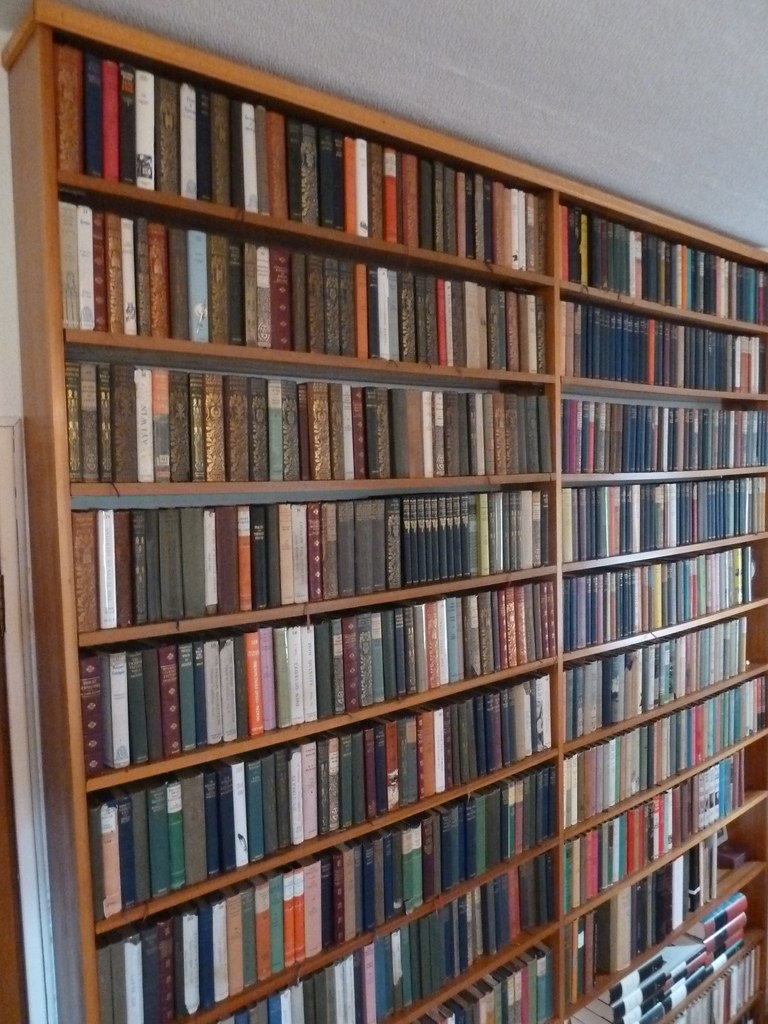
Oxford University Press World's Classics have a special place in our book collection - a purpose built bookcase in our main guest bedroom.


In this bookcase there are some 700 volumes spanning the whole series from "Jane Eyre" (No. 1) to "Mandeville's Travels" (No. 617).

Chronologically this takes us from 1901, when Grant Richards published the first volume, to the early seventies, when the last in the series was published and OUP finally pulled the plug on the original hardback format, so beloved of many readers. (The continuing paperback OUP World's Classics are not lacking in merit, but somehow do not quite have the same feel.)

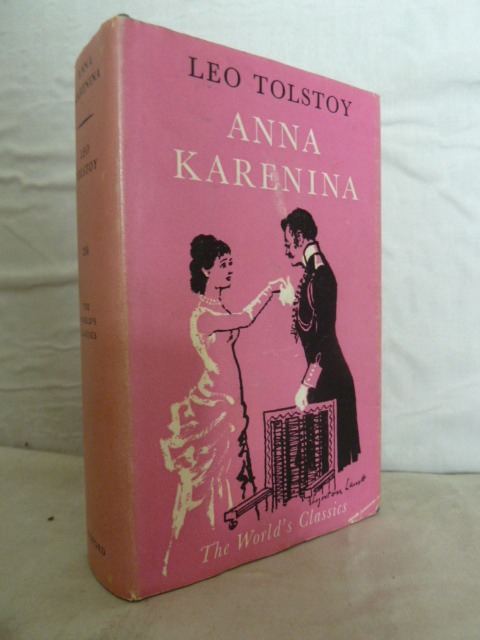
The first World's Classic I ever read was 'Anna Karenina', in 1968 when embarking on solid state physics research near Reading.


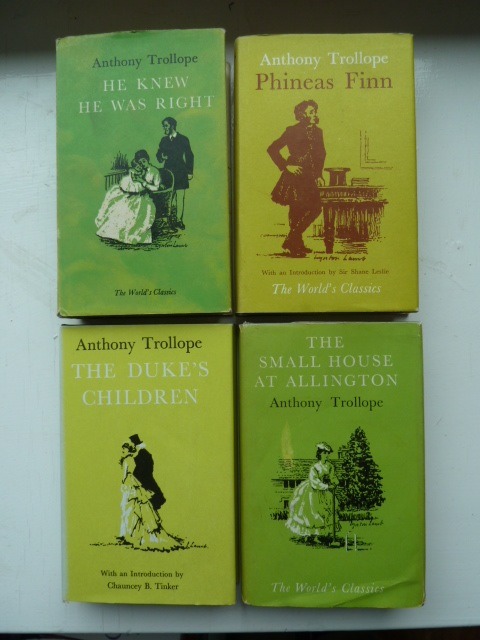
At that time I was in a Tolstoy phase and so it was good to find that he was an author well represented in the series, with no fewer than 20 volumes. It was also a time when you could still buy World's Classics in new bookshops and over the next few years my wife and I added a number of Trollopes to the collection, both new and secondhand. Trollope is the author with the most titles in the series, 36 in all, a virtually complete set of his novels.

It was probably in the early nineties, when our book collection was growing in several directions, that we realised that we had some 10% of the World's Classics, a collection that had appeared on the shelves as by osmosis.


It was then a logical step to make a more determined attempt to collect more of the series; well, alright, to collect all of the series. At first progress was rapid, as local bookshops were searched - then bookshops further afield; I recall a lovely summer day in York which ended in a glut of new titles.

Then a never to be forgotten day in July 1995, when we arrived at the Book Barn in Henneker, New Hampshire, on one of our American trips when we sought out bookshops off the beaten track. It was my family who saw it first. A whole bookcase full of World's Classics, perhaps 200 or so. I have a very understanding family and so they gave me carte blanche to add to the collection (and obtain finer and different copies of titles I already had). This endeavour was assisted by the most amenable of booksellers, who was in a particularly affable mood, in that post lunch period when life seems not so bad after all and discounting for quantity seems a neat idea.

So, it is the late nineties and we now have, maybe, 75% of the series all bought in bookshops by good old-fashioned searching of the shelves.


But we now had the internet and ABEbooks and Amazon, so we could have polished off the whole series fairly quickly. But, I REALLY ENJOY BROWSING FOR WORLD'S CLASSICS. So a GOLDEN RULE OF COLLECTING was formulated. Put simply, this is that any World's Classic missing from the collection can only be added to the collection if it is purchased in a second hand bookshop or at a Bookfair by myself or my family. Seeking the bookseller's help is not allowed. I nearly fell into this trap when a bookseller in Harrogate said he had many more World's Classics in his reserve stock and did I want to see them. The look of horror on my face at this suggestion probably told him this was not a good idea (unless he attributed my blunt refusal to a misinterpretation of his intentions).

Now the hard truth - there are 610 titles (7 of the 617 were projected but never produced). I am still missing 22. The rate of finding new titles is now down to about one a year. Bookshops are closing, I am getting older. I will never finish the collection and this is what gives it its special magic.

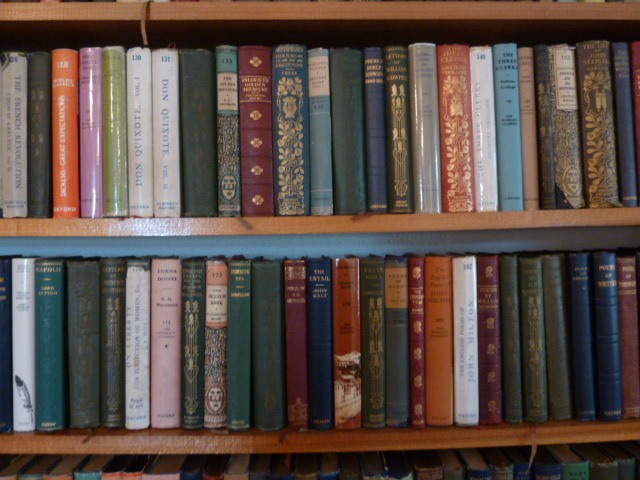
The first 64 volumes in the series were published by Grant Richards; the series was taken over by Oxford University Press (with no change of format) in 1904. These early volumes, cloth bound with elaborate gilt titling and decorations on the spine are particularly attractive. By 1920, the format of the books had become more modern - mainly blue cloth (though some in green, maroon and one or two other colours) with standard dustwrapper designs. Later again, the cloth settled down at dark blue, finally becoming black towards the end of the series, with more pictorial dustwrappers becoming the norm. There are many variants, some were leather bound for example, and most titles were re-printed many times in the different styles.

The range of the series is vast, reflecting the tastes of the publishers of the series from Grant Richards, to Henry Frowde, Humphrey Milford and Geoffrey Cumberledge (of OUP), if a bit idiosyncratic (how do you explain the 9 titles by Constance Holme?)

A few examples:

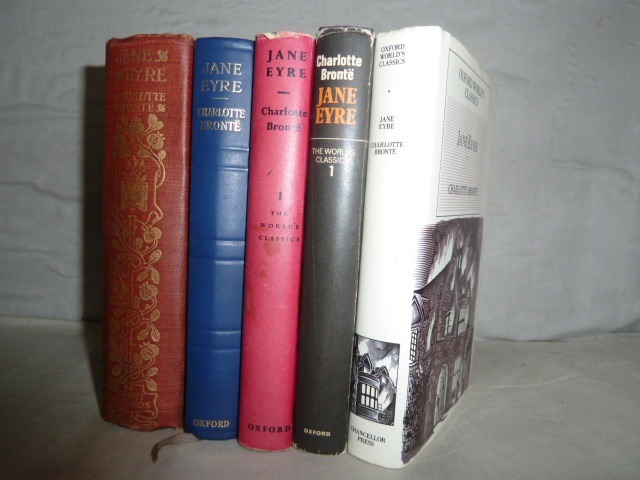
'Jane Eyre' (No. 1) in its different manifestations, from the first edition in 1901, to a 1985 Chancellor Press Chinese reprint of 1985:


"Jane Eyre dustwrappers 1964 and 1974:


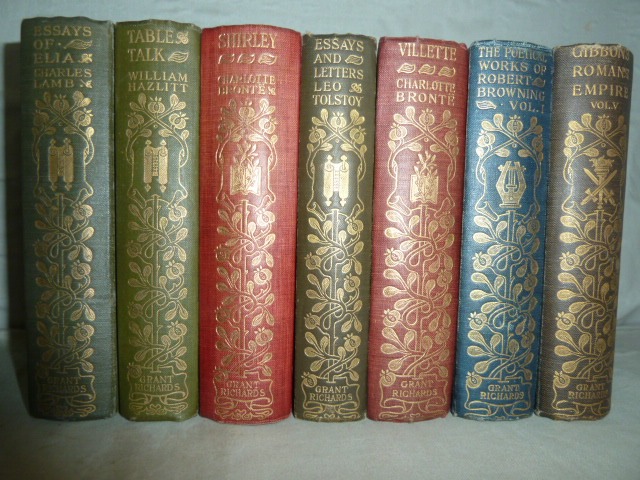
Early World's Classics published by Grant Richards between 1901 and 1904 (Nos. 2, 5, 14, 46, 47, 58, 64):


And some looking very much the same published by Henry Frowde for OUP between 1903 and 1907 (Nos. 9, 28, 36, 73, 99, 144):


Leather bound volumes published between 1904 and 1914 (Nos. 33, 98, 122, 133, 151, 152, 181, 183):


A variant leather binding, these examples between 1926 and 1928 (Nos. 8, 9, 31, 63);


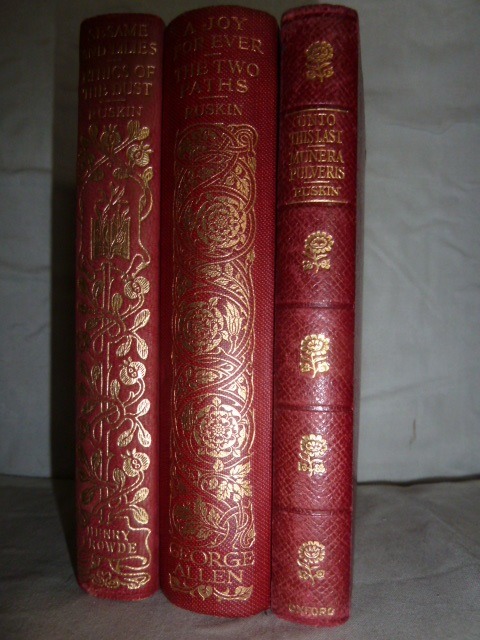
Works of John Ruskin, the only author in the series for which the volumes did not carry a number. These carry the emblem 'Ruskin House Edition' and note George Allen is the publisher of 'A Joy for Ever'. These volumes were published between 1907 and 1923). (Series numbers 145, 147, 148).


Early dustwrappers between 1909 and 1917 (Nos. 7, 47, 73):


The standard green cloth used after the original decorative bindings. These volumes were produced between 1911 and 1928. (Nos. 123, 129, 138, 165, 172, 174, 185, 207, 223).


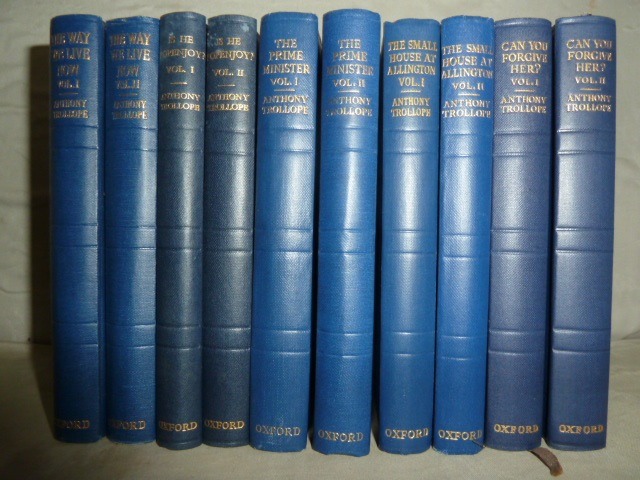
The stately blue cloth that is perhaps the most characteristic binding used by OUP. These double volumes of Trollope were produced between 1938 and 1944 (Nos. 454, 455, 468, 469, 472, 473, 484, 485, 492, 493):


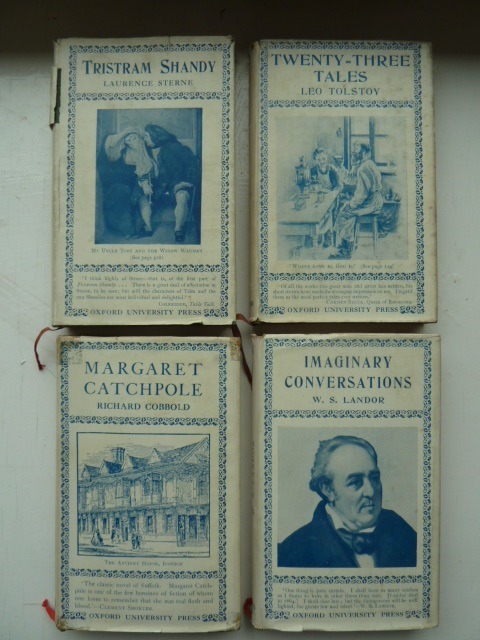
These attractive dustwrappers span the period 1915 to 1929. (Nos. 40, 72, 119, 196)


One of the Standard dustwrapper designs, these examples spanning the period 1935-1951. (Nos. 86, 208, 210, 211, 230, 295)


Another standard dustwrapper design, these examples spanning the period 1926-1937). (Nos. 68, 296, 306, 307, 337, 439, 442)


Two movie tie-ins, the only ones in the series that I know, featuring John Mills (1946) and Charles Laughton (1936) respectively. (Nos. 128, 195)


9 volume set of Shakespeare (No.s 100 to 108) in publisher's slipcase (1933):


Three lovely copies of 'The Three Clerks' (No. 140), dating from 1907, 1925 and 1978):


Attractive dustwrapper designs by Lynton Lamb and Heather Standring ('Northanger Abbey') from the years 1965 and 1966. (Nos. 210, 225, 355, 356)


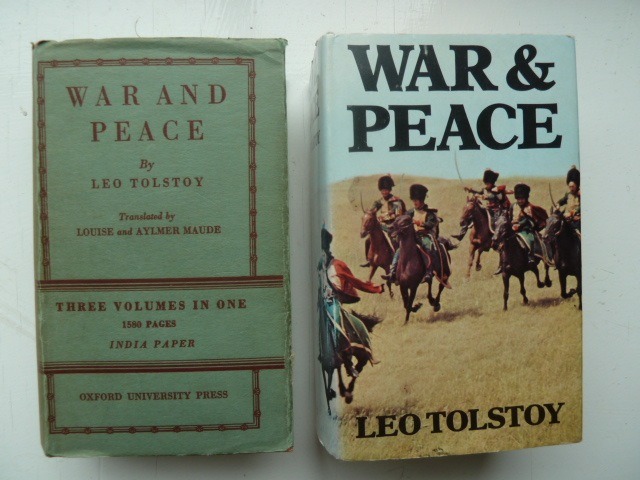
Two dustwrapper designs for the 'three volumes in one' 'War and Peace' (No. 233), dating from 1942 and 1974:


The last OUP World's Classics in their original form petered out in the mid 1970's as the last reprints emerged and a glorious era in book production came to an end.

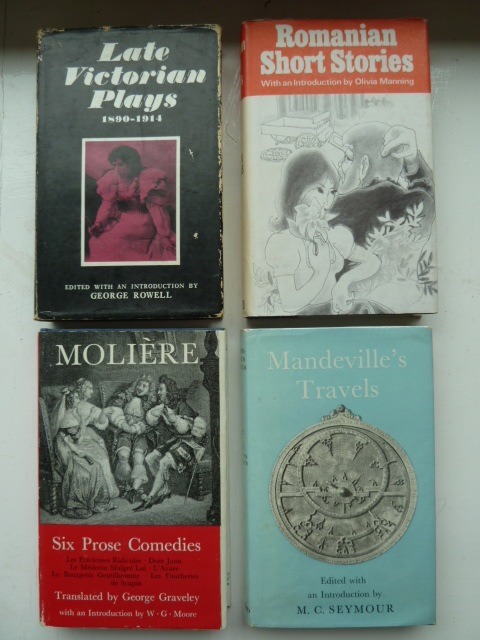
These are the last four World's Classics (to my knowledge, at least three more were planned but I have never seen them):


But then in 1985 something strange happened - in a last sad reincarnation of the series Chinese reprints of some of the titles began appearing, with identical texts and pagination to the books in the original series. This persisted until 1987 and I have seven of these published variously by Chancellor Press, Avenel and Hamlyn.


In conclusion, collecting World's Classics is an absorbing endeavour, with many choices to be made considering that most titles (particularly the early ones) came out in several of the various binding styles and dustwrapper designs used by the publishers. A set of Trollope all in blue cloth looks superb but then you would sacrifice the elegant Lynton Lamb dustwrapper designs.


So it is best left to chance - buy what is there and over the years as if by magic lovely groupings will appear that could almost make you believe you had planned them from the start!