Showing posts with label Wernicke Bookcase. Show all posts

Thursday, 7 April 2011

The Pleasure of Bookcases

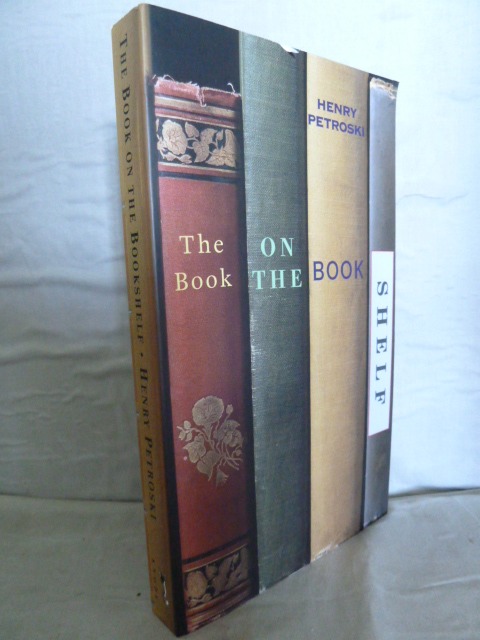
A library may be defined as a collection of books, but unless these are heaped in piles on the floor, it is, of necessity, a collection also of bookcases. A bookcase has been defined, somewhat prosaically, as a piece of furniture used to store books. Further, this will almost always be a system of horizontal shelves with books standing upright with their spines facing outwards. This has not always been the case as the book has evolved from the papyrus roll to the modern codex and conventions for shelving have suffered similar adaptation. To those thirsting for more, the story has never been better told than in J W Clark's magisterial "The Care of Books", whilst a more accessible version is provided in Henry Petroski's "The Book on the Bookshelf".


Musing on such matters prompted me to take a tour of our own library and try to summarise how the bookcases and shelves in our house have responded to the constant influx of books over a reading life.
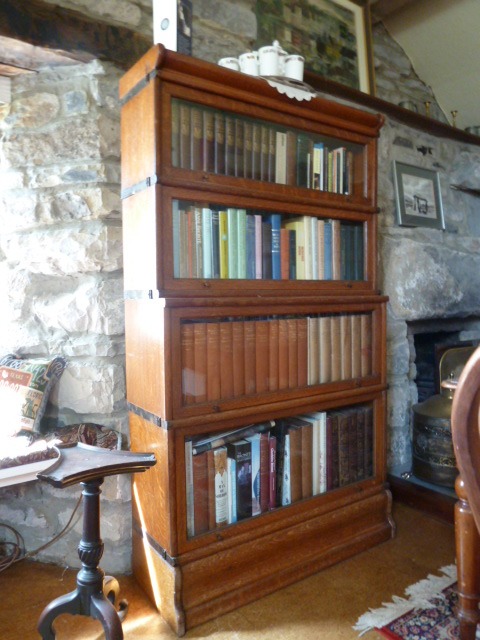

This series of articles began with the Wernicke bookcase of my childhood. There are four such bookcases in the house, with their up and over glass windows and these are good for housing self-contained special collections (in our case, Bronte, Ruskin and ghost stories).
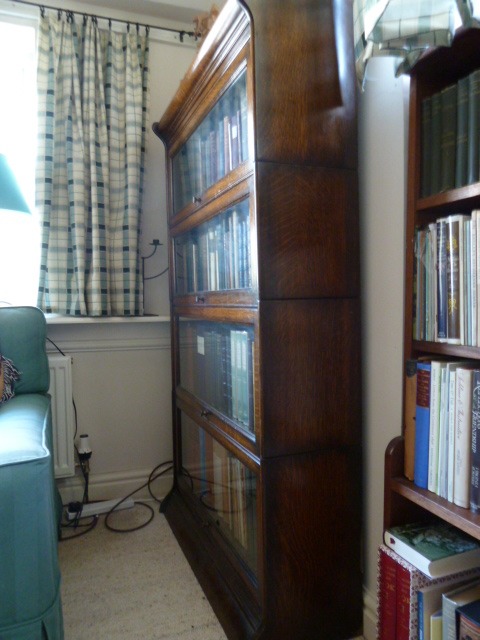


The problem with most Wernicke bookcases is that their shelf sizes tend to limit their contents to octavo and small quarto volumes. Larger books need something different and we found this, initially, in a Victorian mahogany bookcase, which had a wonderfully deep and high bottom shelf and several narrower shelves.
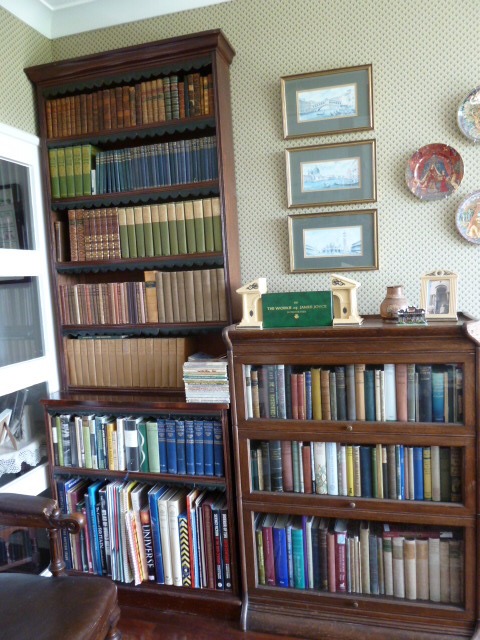

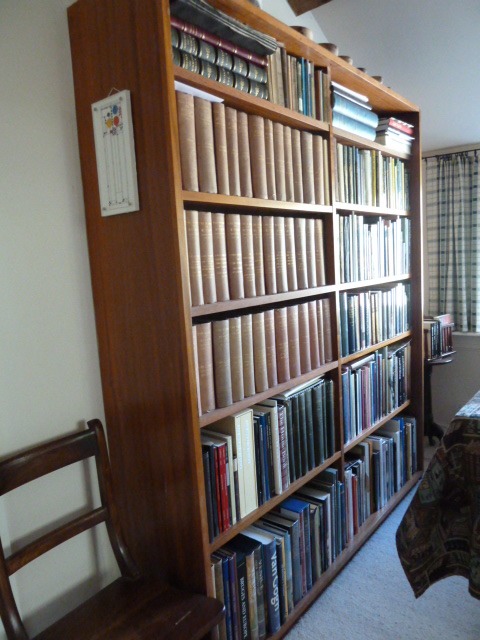
However the time came when our books demanded something more than second-hand bookcases, however elegant, and so we embarked on building our own shelving, from floor to ceiling in, first, a room dedicated to books and, now, in several rooms and corridors. These shelves are exclusively built from planks of parana pine with shelves supported from the uprights by simple metal brackets.
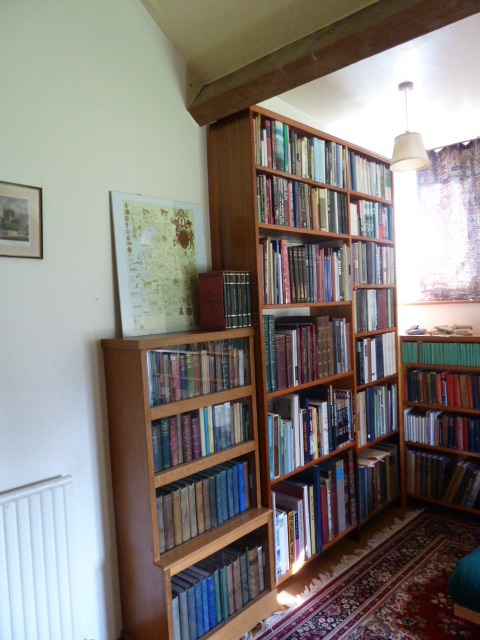
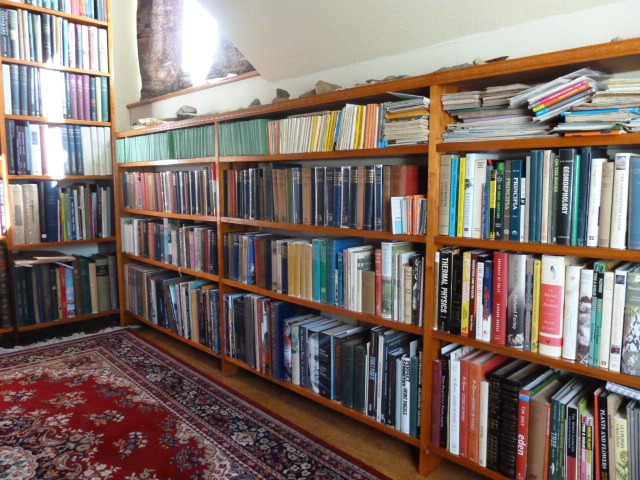
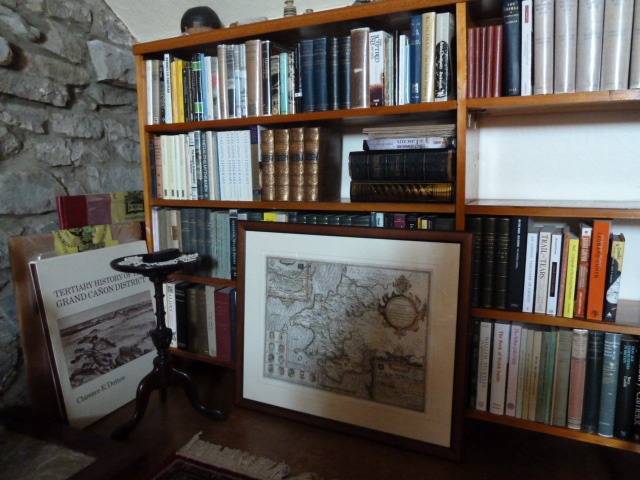


To avoid shelves sagging under the books, wood of order one inch thick is needed with shelf spans never more than four feet. Now, the shelves can be spaced according to the books, a bibliophile's dream! As to shelf width 9 inches is normally fine; we, do, however, use 12 inches for one of the bays, for larger volumes and 6 inches for paperbacks and our collection of 'World's Classics'.
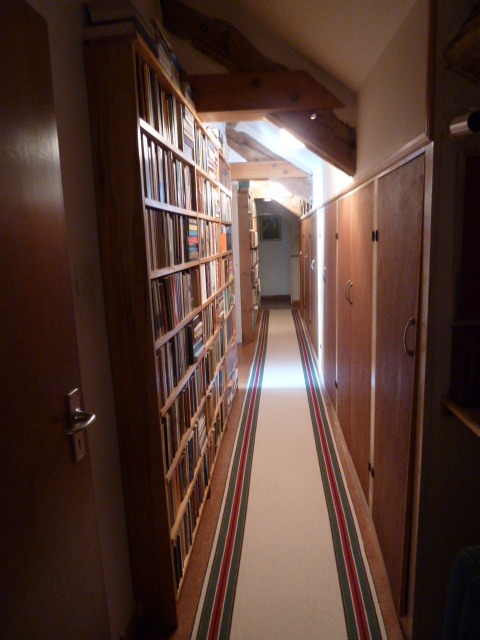
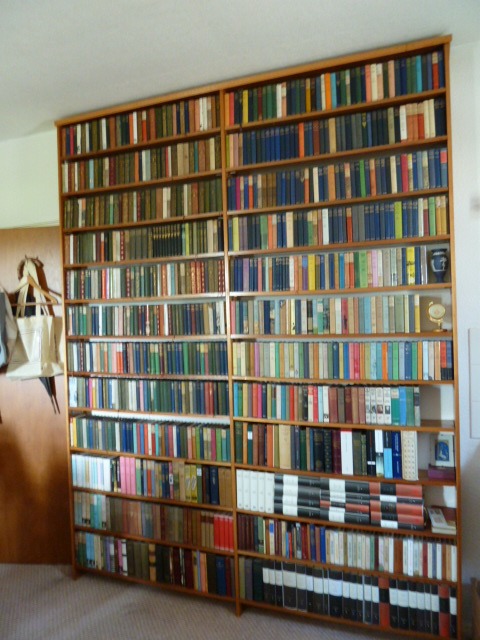


Another input to our book space came when the Carnforth Bookshop closed its short-lived branch on Church Street, Lancaster, when, as the shop was being cleared, we hired a van and took some of their shelving (we also have some Borders shelving,following their recent demise in the UK).
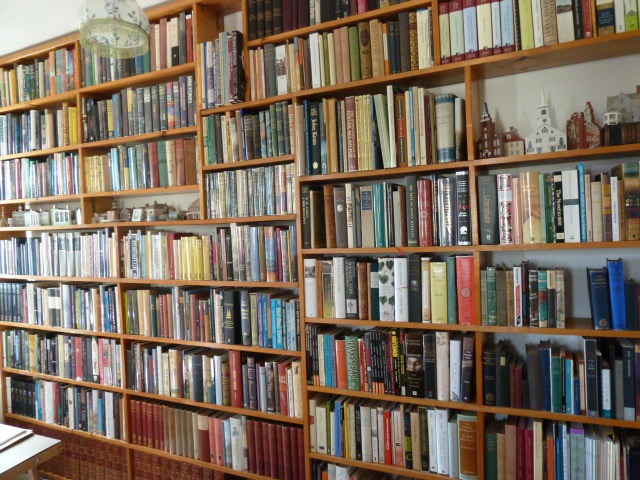

In recent years, we have become aware of the excellent IKEA Billy Bookcases and several of these have migrated from the local store into our house. A great attribute of these is that you can affix glass doors to them and they do then present a very handsome appearance, particularly several side by side.
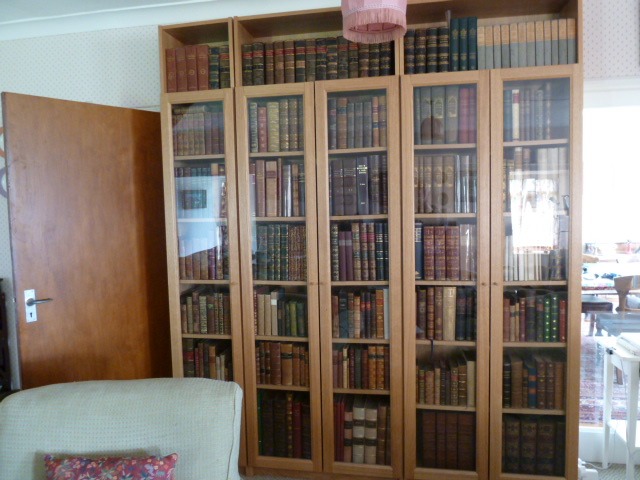
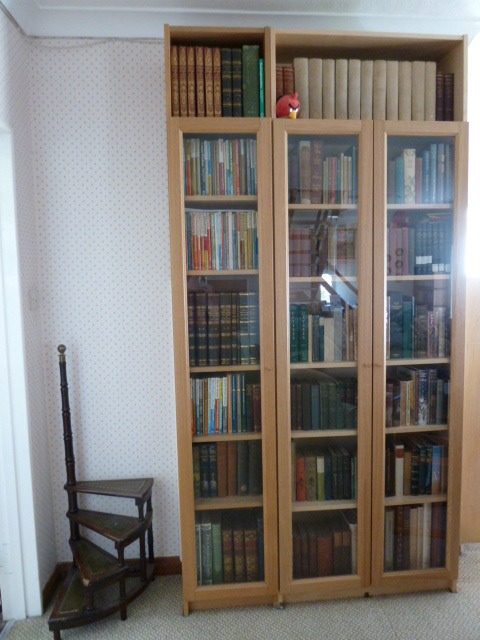


Again, with adjustable shelf height and deep shelves there are not many book sizes that they cannot accommodate. I have mixed feelings about books behind glass, but on balance keeping dust away from a book is probably the single greatest act of kindness you can bestow on a cherished volume. Books on open shelves require dusting along their top surfaces at least once a year to prevent build up of mould. And just in case you think I am paranoid see "The Enemies of Books", by William Blades.


It only remains to draw attention to one or two of the other bookcases that live in odd corners and accommodate particular micro-collections.

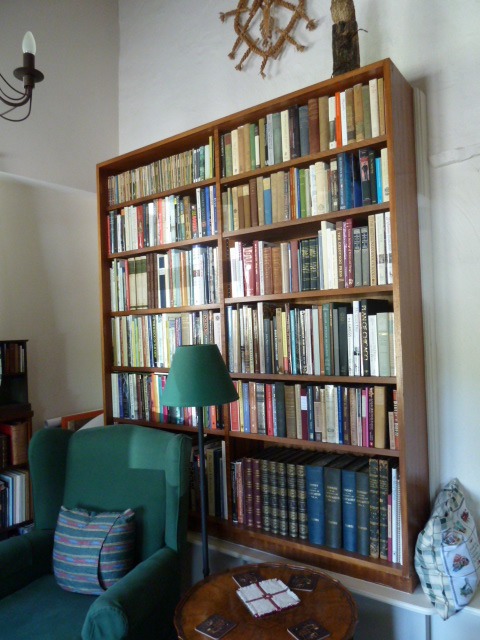
Deep library shelving, with adjustable height using Tonk's Studs ....


A rotating bookcase, perfect for Baedecker and Thorough Guides ....
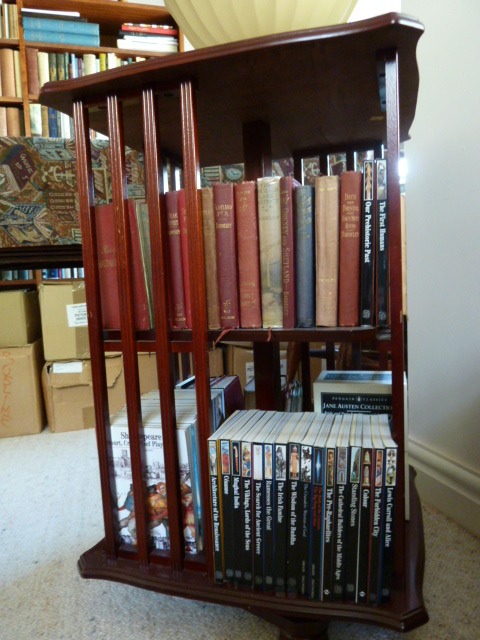

Another rotating bookcase ......
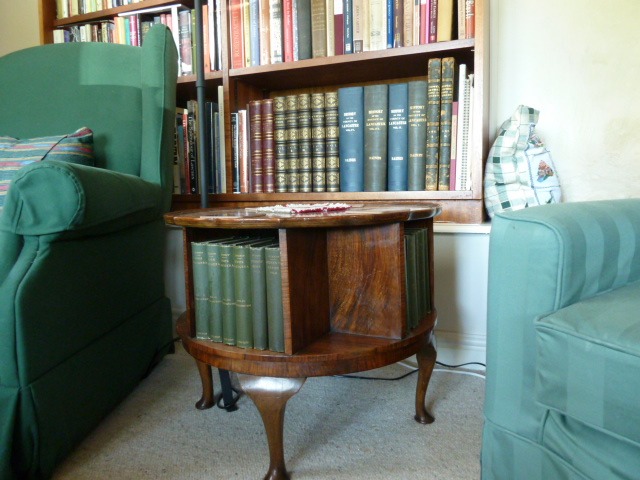

And yet one more ......


A 1960's 'White Wood' bookcase from Heelas in Reading (the first bookcase we actually bought ....)
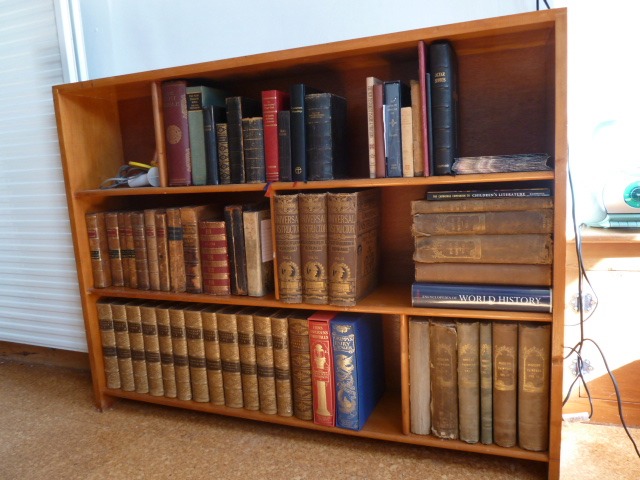

And finally a display cabinet, with the upper part used for a small special collection.
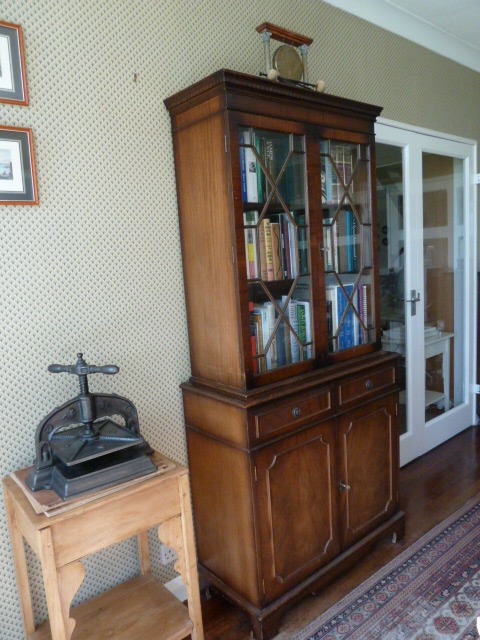

The question may arise as to what happens when literally there is no space for a single extra book, let alone bookcase. Moving is probably the best fix.

Posted using BlogPress from my iPad

Wednesday, 1 December 2010

The Top Shelf

OK

Why write about books when there are already more books about books than can be read in a lifetime?

Because I am going to write about my books and these have never been written about before. 'Ah', you may say, 'Yes, they have'. But, actually, no - my books and their relationship with me have never been written about. For, example, my copy of 'Jane Eyre' is not the same as your copy; you see my copy is intricately bound up with childhood terrors concerning Bertha Mason, when we were allowed to watch the 1956 series on TV, family visits to Haworth to marvel at the 'Little Books' and serious attempts at unravelling the social significance of The Madwoman In The Attic. Your 'Jane Eyre' can similarly only be interpreted in the context of your experiences and influences.

So, that is in way of an apology, or perhaps an excuse. It all began with the bookcase. Looking up, I see the bookcase in the corner of our present lounge. It is of the type known as Wernicke, sold, I believe under the Globe Wernicke brand. As a child, this bookcase was my introduction to the world of books, or, more specifically to the concept of a collection of books.

The bookcase had four shelves, each with its own up and over hinged door, lifted by two brass knobs on the front. It was only later that the true elegance of the design was revealed when first I moved the bookcase from my parents' home to our first house in Hampshire. This is the ease with which each shelf lifts off as a single 'box' when the bookcase is dismantled. But I will return to the subject of bookcases later; a very important subject since it is my belief that a collection of books properly shelved forms an entity independent of the sum of the books as individual objects.

But first I must return to that bookcase of childhood, since it is here that the story starts. Picture a large Cheshire farmhouse, brick built and, to a child, steeped in legend and mystery. In the farmhouse was a parlour, this being the room that the family lived in, rather than the austere drawing room, reserved for special occasions. In the parlour was a fireplace and a sideboard, chairs and a settee. In the corner next to the fireplace was the bookcase, where behind the glass doors was my father's collection, with a few stray school prizes belonging to my mother.

At first sight the books in the bookcase would not appear to be exactly what a child would pore over; but even a run of 'The Border Leicester Year Book' can hold surprising excitement. The books were, I suppose with hindsight, the typical collection of a farmer with 150 acres to maintain, growing up in the First World War, feeding the nation through the Second World War and holding a responsible position within the farming community of South Cheshire in middle age. So, it is time to make a list, drawn randomly from memory -

'History of the Great European War ', Anon, 8 volumes, decorated red cloth
'The Great War', Churchill, 3 volumes, red cloth
'The Years of Endurance/Victory/Elegance', (the latter, strictly, an Age), Bryant
'Hutchinson's Standard Life of Napoleon', Bourrienne
'The Invasion of the Crimea', Kinglake
'The Reason Why', Smith
'Barlasch of the Guard'
'Exploits of Brigadier Gerard'

By now a picture is emerging and it is probably simple to deduce that, after the usual childhood fare, the first author who I consciously sought out (thank you Bury Public Library) was G A Henty. 'Jack Archer', 'With Lee in Virginia', 'Redskin and Cowboy' - these were a staple fare, together with,of course, William and Jennings.

There were also several of my mother's books, mostly school prizes and invariably of a sentimental or self-improving nature. Thus I was introduced to the world of girls' schools via 'Dauntless Patty' and of family bereavement via 'Kathleen' by one Agnes Giberne, with chapters titled 'Shadows in the Home' and 'Dark Days', enough to soften the heart of the most recalcritant 8 year old. However, I am sure that it is to these contrasting sub-collections in this cherished bookcase that I can explain some of the byways of book collecting that I subsequently followed.

In the next part of the story, I will fast forward 60 years to the present contents of the bookcase.