Showing posts with label H P Lovecraft. Show all posts

Monday, 23 April 2012

From Arkham House to Sauk City via H P Lovecraft


In June 2010 we drove into Sauk City in rural Wisconsin; not a big place, but typical of many American small towns and well looked after by its residents.

This was in the way of a pilgrimage. As a teenager I had devoured the stories of H P Lovecraft and was aware that most of these first saw publication in book form in a volume called "The Outsider and Others", published by Arkham House at Sauk City, Wisconsin. For a long time this remained a name of legend, more imagined than real; another creation, if you like, of Lovecraft's dreams and nightmares.

I had never imagined that one day I would actually see an Arkham House book, let alone own one. But then, at Ilkley Book Fair in the late 1970s, a copy of an early Arkham House book was displayed on one of the stands. This was "The House on the Borderland" by the British writer William Hope Hodgson, another favourite author.


After initial hesitation on account of the price, the book returned home with us and was the first of a number of Arkham House volumes that now are housed in a separate bookcase.

It was the death of H P Lovecraft in 1937 that led to the founding of Arkham House. Up to that time Lovecraft's stories had been largely confined to pulp magazines such as 'Weird Tales'. However, two of his admirers, August Derleth and Donald Wandrei, felt that his work deserved more solid recognition. After failing to find a mainstream publisher (Derleths's publishers Scribner's turning the idea down) they founded their own publishing house and in 1939 brought out "The Outsider and Others", a large volume containing the best of Lovecraft's work.


Since then Arkham House has continued to publish works of other authors and continues to this day, though under new ownership. Their catalogue contains much of the best of what has been termed 'weird fiction', i.e. ghost and horror stories, science fiction and fantasy.

Arkham House, after a slow start, produced some 40 titles in its first decade. Some of the authors were previous pulp fiction regulars such as Robert E Howard and Clark Ashton Smith and further volumes of Lovecraft appeared regularly.


August Derleth also contributed some of his own copious work. However, they also published mainstream gothic and ghost story writers such as J Sheridan Le Fanu, Algernon Blackwood, Lady Cynthia Asquith, L P Hartley, Walter de La Mare, Arthur Machen and H Russell Wakefield.


In 1947 one of Arkham House's most desirable (and hence now most expensive) books was published. This was the debut volume of science fiction stories by Ray Bradbury, "Dark Carnival", (published later in the UK as "The October Country"). This volume contains some of Bradbury's best and most anthologised stories such as 'Skeleton' and 'The Small Assassin' and is sadly not on our shelves. The 1950s, 1960s and 1970s saw more works by August Derleth, reprints and further compilations of Lovecraft, including his letters, published in 5 volumes by Arkham House.


Robert Bloch, author of 'Psycho' and admirer of Lovecraft, was also featured. Works by the British writers M P Shiel and William Hope Hodgson also appeared. The British fantasy author Ramsey Campbell saw his first appearance in print in 1964 when Arkham House brought out "The Inhabitants of the Lake and Less Welcome Tenants", the result of correspondence between the teenage Campbell and August Derleth.


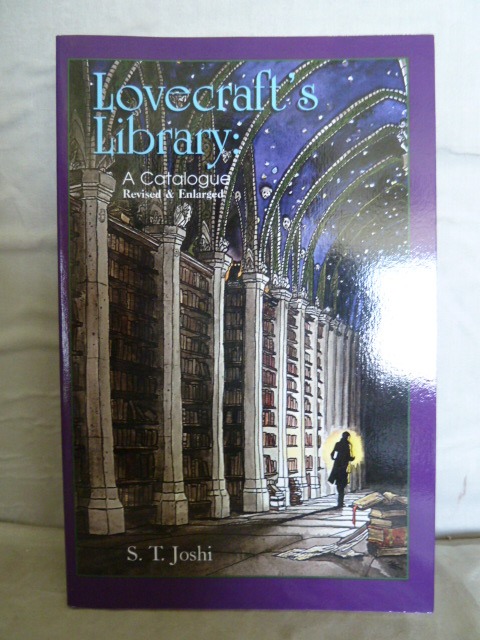
In 1999 a history and bibliography of the press was published, edited by Derleth's successor as Lovecraft's editor, S T Joshi as the 192nd Arkham House book.


Fittingly the next volume was a retrospective 60th anniversary anthology entitled "Arkham's Masters of Horror". It is nice to report that I obtained both these volumes new during holidays in the USA.


Nowadays, Arkham House books are found more often in the UK, but our own collection of Arkham House books is a constant reminder of exciting visits to bookstores in the USA. On our pilgrimages to Lovecraft's home town of Providence, we have browsed in bookstores old and new and it is good to find that he is remembered so well in the city he loved so much.


In a rather down at heel section of North Main Street we found the Other World's Bookstore and here was perhaps the most complete set of used Arkham House volumes I have encountered in a single bookstore. Fortunately, across the street was a 'Dunkin Donuts' where the family could regroup and gain confidence for the forthcoming purchases. Then in downtown Providence is the excellent Cellar Stories Bookstore where other volumes have been found.


Of the new bookstores the Brown University Bookstore on College Hill, near Lovecraft's home, were selling bookmarks with Lovecraft quotes on when we visited. And at one new bookstore, on our first visit to Providence I first saw the 3 volume Arkham House edition of Lovecraft's works and the 5 volumes of the letters, all new and gleaming in protected dustwrappers. All were in our luggage on the journey home.


Other favourite USA bookstores, where I have bought Arkham House volumes are the Avenue Victor Hugo bookshop in Boston (now gone), Allen Scott in Portland, Maine (also gone), By the Book in Phoenix and, the late lamented Borders in Boston, which often had in print titles.

It is good to see that Sauk City remembers the writer who made the name a magnet for afficionados of weird fiction. In a prolific career, August Derleth produced many novels set in his native Wisconsin, volumes of poetry and pastiches of Sherlock Holmes. But, I suspect it is as the founder of Arkham House and protector of Lovecraft's legacy that he will be best remembered.


It is perhaps an irony that, for a writer once so ignored by the mainstream, publishers are now competing to bring out new editions of Lovecraft's stories. In recent years we have seen editions by Penguin Modern Classics, Vintage, Gollancz, Barnes and Noble and the prestigious Library of America, recognition, albeit belatedly, of August Derleth's judgement in launching the imprint that kept Lovecraft's name alive.

- Posted using BlogPress from my iPad

Sunday, 10 April 2011

Bookplates and the DIspersed Library

Unless you are a Samuel Pepys or Thomas Jefferson then it is almost inevitable that, however fine your library, there will come a day when it will be divided, sold, given away or otherwise dispersed. This is not necessarily a bad thing, since out of the debris of once coherent collections emerge new private libraries and new material for the great public collections. It is an endless recycling that is the wellspring of the collector's joy as long sought after books appear at auction, in bookshops and on on-line book sites.

Many collectors mark their books in some way to identify their ownership. This may be by a simple signature, or by the inclusion of a personal bookplate normally affixed to the front pastedown. First edition fetishists may recoil in horror at the thought of an otherwise pristine copy being defaced in this way, but to a true booklover such symbols of ownership become a new trail to explore. They also make a tangible connection between you and that other owner - you have both handled (and hopefully read) this very copy.

Over the course of our collecting life, both by chance and design, many books with interesting bookplates, or other signs of ownership, have found their way onto the shelves. Here is a sample:


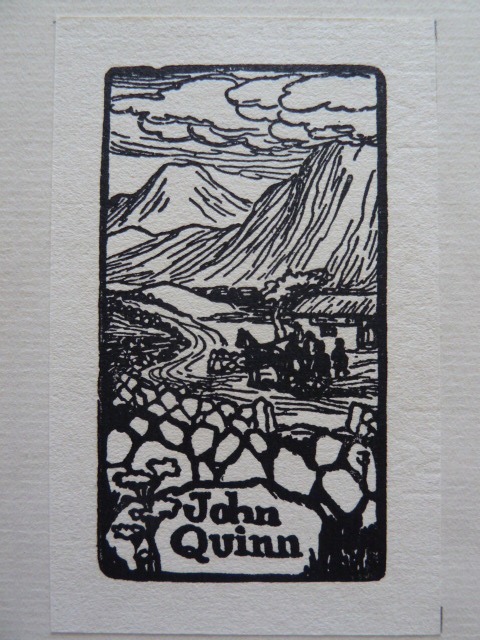
The bookplate of John Quinn in Arthur Machen's "The Three Imposters" (John Lane, 1895). This bookplate was designed for Quinn by Jack Butler Yeats. Quinn was an American lawyer and eminent collector of modernist works. He was a patron of many literary figures, including W B Yeats, Ezra Pound and James Joyce, from whom he puchased the manuscript of "Ulysses" (now in the Rosenbach Museum, Philadelphia). Quinn also successfully defended Joyce's "Ulysses" against obscenity charges. So, I now have in my hand a book from a collection that contained the manuscript of "Ulysses". Could it get much better?


The bookplate of novelist Dennis Wheatley in Forrest Reid's "Walter de la Mare: A Critical Study" (Faber and Gwyer, 1929). Wheatley's library was sold by Blackwell's in 1979 and this was Item 1806 in their catalogue.


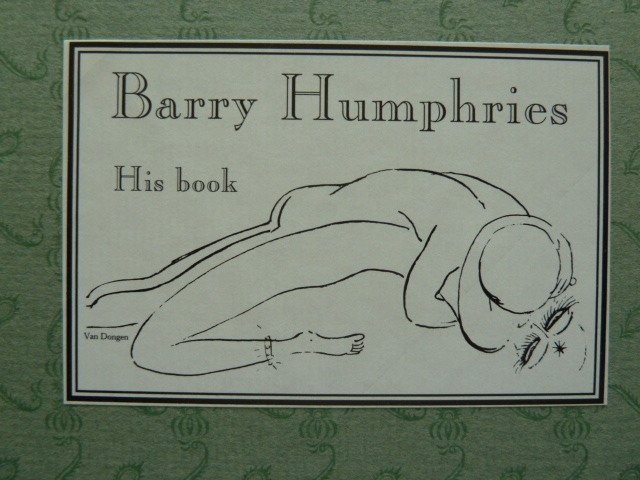
The bookplate of comedian Barry Humphries in Arthur Machen's "Ornaments in Jade" (Alfred A Knopf, 1924).


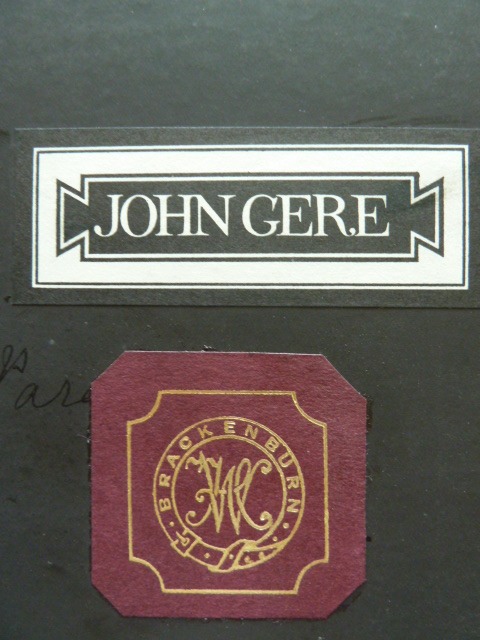
Two for the price of one - the bookplate of novelist Hugh Walpole's Brackenburn Library and that of art historian and curator John Gere in J Sheridan Le Fanu's "Wylder's Hand (Hutchinson, no date). A pencil note by Gere says that this copy was purchased at the Christie's sale of Walpole's library on 11/2/46.


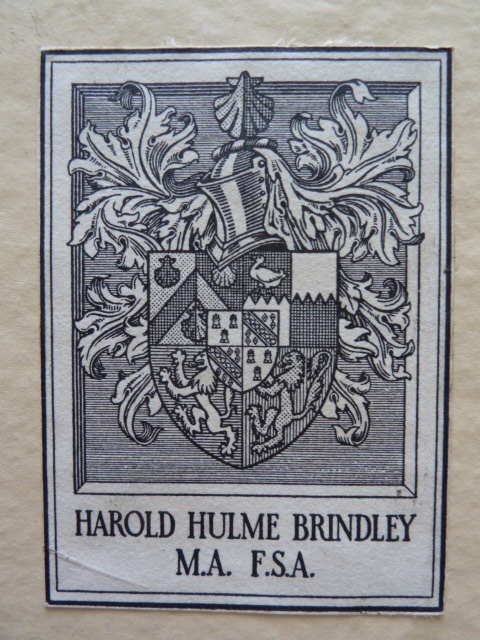
The bookplate of Harold Hulme Brindley, naturalist, in M R James' "Ghost Stories of an Antiquary" (Edward Arnold, 1904). Brindley knew James at Cambridge and this copy contains a manuscript letter from MRJ to Brindley as well as illustrations of the scenes in the stories pasted into the book by Brindley, making it a very special copy - far from a pristine first but infinitely more interesting.


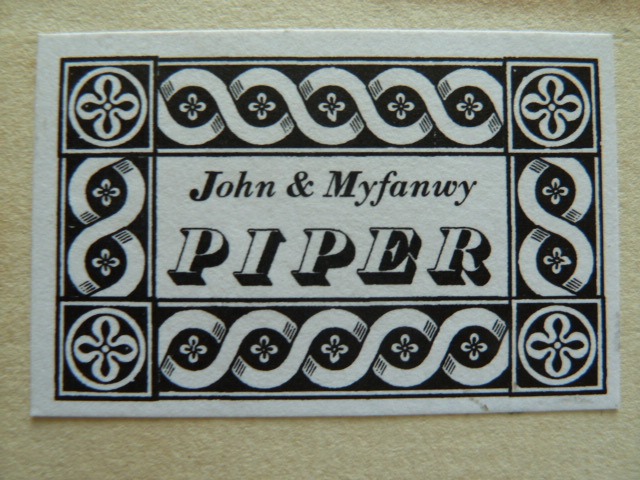
The bookplate of John and Myfanwy Piper in John Ruskin's "Modern Painters" (George Allen, 1888).


The bookplate of Isambard Brunel (son of the engineer) in John Ruskin's "Stones of Venice" (Smith Elder, 1851)


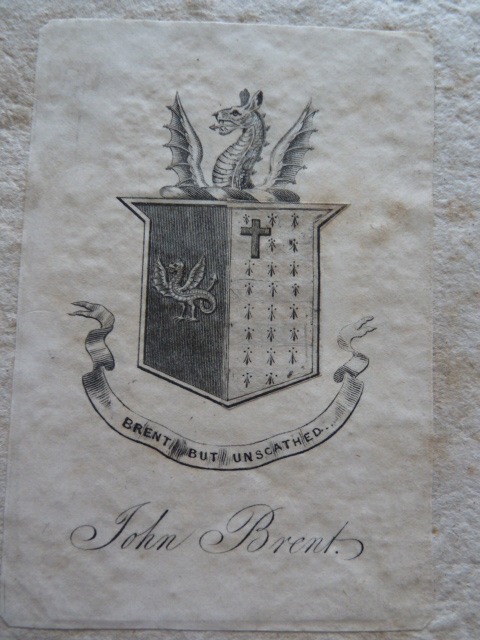
The bookplate of John Brent, antiquary and novelist in Henry Rowlands' "Mona Antiqua Restaurata" (Dublin, 1723).


The bookplate of Vincent Starrett, bibliophile, author and Sherlock Holmes afficionado, in his own book "Penny Wise and Pound Foolish" (New York 1929). This bookplate was designed by the illustrator Gordon Browne (son of H K Browne ('Phiz')).


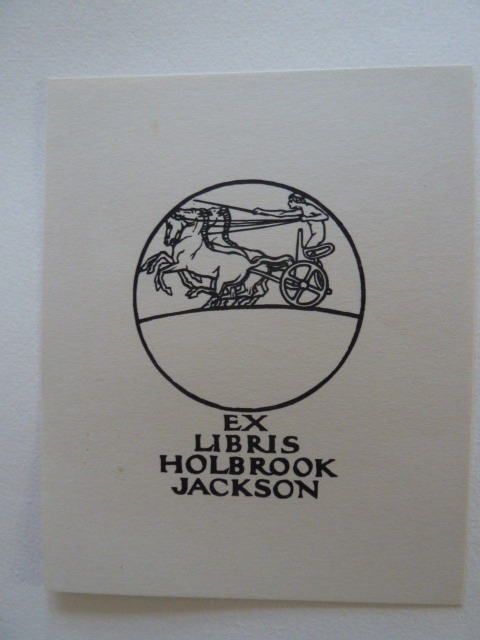
The bookplate of bibliophile, collector and writer about books, Holbrook Jackson, loosely inserted in the copy of James Joyce's "Storiella as She is Syung" (Corvinus Press, 1937), presented by the owner of the press, Viscount Carlow, to Jackson when he visited the press on 12th April 1938. Interestingly, Viscount Carlow has written a suitable presentation inscription to Jackson in ink on a preliminary blank page, but Jackson, perhaps in deference to the beauty of the book, did not paste in his bookplate.


John Ruskin's Brantwood bookplate in Mrs Oliphant's "The Makers of Florence" (Macmillan 1877). Care is needed with Ruskin bookplates since, after the dispersal of his library, it is almost certain that some bookplates purporting to be Ruskin's were printed and inserted in books not from his library to increase their value. The story is told in James Dearden's "Facets of Ruskin". The example shown dates from circa 1890 and probably indicates Ruskin ownership of this book.

It has become a standard exercise now to try to compile lists of books in authors' libraries long dispersed. In our collection we have books with such lists for James Joyce's Trieste library, Ruskin's library, Lewis Carrol's library and H P Lovecraft's library.


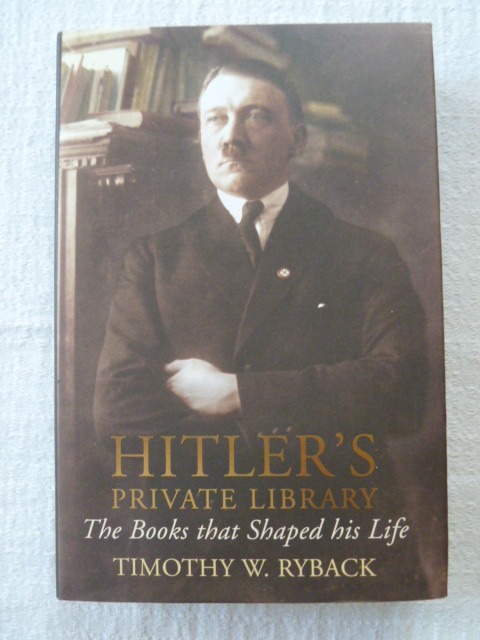
There are recent books on Oscar Wilde's library and even Hitler's private library.


It was in Peter L Stern's superb bookshop in Boston that I had in my hand H P Lovecraft's copy of M R James' "A Thin Ghost and Others" with both Lovecraft's bookplate and his signature. Sadly I replaced it on the shelf to await another traveller in the realms of phantom libraries, or, to be perfectly honest, we couldn't afford it.


- Posted using BlogPress from my iPad

Monday, 17 January 2011

Macabre Readings


From the Grammar School, across the River Dee in Chester, to the bus station on Delamere Street was a walk of about a mile - across the Old Dee Bridge, up the hill of Bridge Street, over the cross and up Northgate Street to the bus station. I had exactly 30 minutes to complete this journey after school finished, just allowing time for at least one book-stop along the way. I had at this time developed a liking for short stories of the more macabre kind, having grown up on a diet of the more traditional ghost stories.

There were two choices. A passage to the left of the imposing front of Chester Town Hall led past the bar once run by the legendary Everton Centre-Forward, Dixie Dean, into Chester's indoor market. Here was located a 4-sided stall run by one Mark Bloom, who had the enviable knack of knowing exactly what comics and cheap paperbacks would appeal to an 11-year old, with a penchant for horror. The second option was a short diversion down Watergate Street to Thompson's, a newsagent with a surprisingly good stock of cheap paperbacks with sensational covers, more or less opposite the impressive God's Providence House. It was from these two non-traditional sources of books that during the early 1960's I built up a small, but valuable (to me, at least) collection of paperbacks containing ghost and horror stories, in the days when W H Smith and established booksellers did not stock such material.

Pre-eminent amongst these was my first collection of H P Lovecraft, the World Distributor's Library edition "Cry Horror". I don't know why Lovecraft's complex and sometimes tedious writing style appealed so much but there was something about the stories, the language and the descriptions that captivated me and stories such as 'The Colour out of Space', 'Pickman's Model', 'Arthur Jermyn' and 'The Nameless City' remain favourites after more than 50 years. This was followed up by an excellent Panther collection "The Haunter of the Dark and Other Tales of Terror".


These stories introduced me to the towns of Lovecraft's imagination: legend-haunted Arkham (actually witch-ridden Salem, with it's historic sites and many-gabled houses) and Innsmouth (Lovecraft's beloved Marblehead). It was at Arkham's Miskatonic University Library that seekers after dark secrets could find a copy of the "Necronomicon" by the mad Arab Abdul Alhazred, whose enigmatic couplet "That is not dead which can eternal lie and in strange aeons e'en death may die" is much quoted in Lovecraft's stories.

Since then, my family and I have wandered in Lovecraft's footsteps through the streets of Salem, Massachusetts, and Providence, Rhode Island, and have sought out early Arkham House titles in the latter's bookshops. Lovecraft is one of the few writers of what might be called pulp fiction (he first published in "Weird Tales" magazine) to make the transition to being recognised as a serious writer, as evidenced by the inclusion of a volume of his best works in the Writers of America series. It was not however in Lovecraft's New England, but in up-market Santa Monica on the Californian coast, that I finally found my copy of the "The Outsider and Others", the first Arkham House title and the first book publication of Lovecraft's best work. Having a very understanding family, it was perhaps not surprising that on my 60th birthday, my elder daughter presented me with another Lovecraft Arkham House title, "Dreams and Fancies", almost 50 years after my initiation into Lovecraft's strange world.


Also published by World Distributor's Library was the excellent collection "The Midnight Reader", with a very good introduction by Philip van Doren Stern. In here were to be found such masterpieces as 'The Yellow Wall Paper', by Charlotte Perkins Gilman, in which a woman becomes obsessed with the patterns in the wallpaper of her bedroom and ends up crawling round the room over the body of her horrified husband (who has fainted in shock at her state), and Algernon Blackwood's 'The Willows'.


Excellent stories were also to be found in the Digit collection "The Macabre Reader", edited by Donald A Wollheim and the early volumes of Herbert van Thal's series of Pan Books of Horror Stories. I particularly liked John Martin Leahy's 'In Amundsen's Tent' in "The Macabre Reader". This collection also contained Lovecraft's 'The Thing on the Doorstep'.

Panther published several volumes of Arthur Machen (of whom more will be said in a later blog) including "Tales of Horror and the Supernatural". These were rapidly added to the bedside table as also were the Arrow editions of Bram Stoker's tales of the supernatural.


I also recall the thrill of finding on the Market stall the World Distributor's Library edition of Henry James' "The Turn of the Screw", in which edition, with its lurid cover, I first read this ghostly masterpiece. I still find the never-ending debates on this story fascinating, but as would be expected for a dedicated reader of ghost stories, I am inclined to think the Governess entirely sane and the phantoms of Peter Quint and Miss Jessel not of her imagination, but real projections of malevolent forces through the tenuous veil that separates our comfortable world from the dark forces lurking at the threshold.


Following this initiation into such stories, there followed a long period in which university studies and career building limited opportunities for seeking out new authors and those I did seek out were of a more serious literary nature. However in 1981, I bought, on an impulse, the excellent compilation "Dark Forces", edited by Kirby McCauley. This introduced me to a new generation of writers of supernatural stories such as Ramsey Campbell, T E D Klein, Poppy Z Brite and Karl Edward Wagner, who took many of the themes of the earlier masters, but transposed them into modern, often urban, settings. The loneliness of old empty houses is replaced by the alienation and isolation found in crowded streets, where more modern terrors await the unwary.


I have noted the current popularity of all forms of supernatural fiction, from out and out horror to the romance of the 'dark fantasy' paperbacks (now a separate genre in Waterstone's). However, you can, perhaps, have too much of a good thing and I would not have wanted to forego the thrill of discovering those classic tales by digging around in out of the way places when such finds were rare.

- Posted using BlogPress from my iPad