Showing posts with label M R James. Show all posts

Wednesday, 2 January 2013

The Best Ghost Story Collections


Winter is the season of ghosts, as doors rattle and creak in the wind and bare limbs of trees tap at the window pane. It is a time to huddle round the fire with a good book and what better reading could there be than a ghost story? It was a tradition when I was young to choose a volume of ghost stories for a Christmas present and that tradition to some extent lingers with me still, made easier nowadays by the collections published by the excellent supernatural small presses such as Ash-Tree Press, Tartarus Press and Swan River Press, not to mention the copious volumes reprinted by Wordsworth Editions in their 'Tales of Mystery and the Supernatural' series.

However, for all the ghost stories written, there are a surprisingly small number of books of ghost stories that can be considered truly great, and here I mean books by a single author, not anthologies with multiple authors (which I will cover at a future time).

Over the years, some of these books have found their place in the High Barn Library and I have chosen just nine, with one exception spanning the 60 or so years between 1872 and 1930, during which period the literary and psychological ghost story forms reached their zenith.

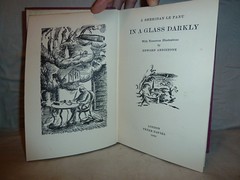
'In a Glass Darkly', J Sheridan Le Fanu, Richard Bentley (1872)


In this outstanding volume, Le Fanu probes the boundary between the supernatural and the psychological, particularly in 'Green Tea', one of the most anthologised of ghost stories, in which the unlucky Revd. Jennings is haunted by a green monkey. Other oustanding stories are 'The Familiar', 'Carmilla', with its lovely but deadly vampire, and 'Mr Justice Harbottle', the hanging judge who receives his death sentence from a terrifying supernatural court. Le Fanu wrote many other ghost stories, but it is in this volume that his powers are fully realised.

'Hauntings: Fantastic Stories", Vernon Lee, Heinemann (1890)


The lyrical prose and beautiful topographical descriptions in these four stories add considerably to the supernatural content. The author is equally at home in the Venice of 'A Wicked Voice' as in the Kentish countryside of 'Oke of Okehurst'. Montague Summers justly praised her genius in his excellent introduction to 'The Supernatural Omnibus', including two of these stories in that volume.

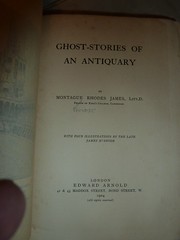
'Ghost Stories of an Antiquary', M R James, Edward Arnold (1904)


There is a problem here about which of the four collections of ghost stories written by M R James to include. My heart is perhaps with the second collection 'More Ghost Stories' (1911) containing 'Casting the Runes' and 'The Tractate Middoth', the first volume of James I encountered, aged about 10. However, with the head I have to select the first he published, which includes the incomparable 'Oh, Whistle, and I'll Come to You, My Lad', not to mention 'Count Magnus', 'Lost Hearts' and 'The Ash-Tree'.


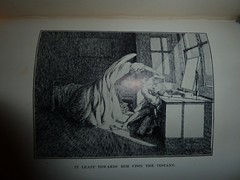
This was the only of his first editions to be illustrated and the drawings of James McBryde (who died before its publication) add considerably to the book. In these stories we are shown the dangers inherent in raising the spirits of the dead and that too much intellectual curiosity can be a decidely dangerous thing.

'John Silence, Physician Extraordinary', Algernon Blackwood, Eveleigh Nash (1908)


I do not normally like stories involving supernatural sleuths, but Dr. John Silence is different and in the best of the five stories in this volume is an inconsequential figure. These are predominantly, as in much of Blackwood's ghost (or, more correctly weird) stories, studies of the influence of place on susceptible minds. From the sleepy northern French town of 'Ancient Sorceries' with its supernatural cats to the mysterious brotherhood in the sleepy southern German town of 'Secret Worship' and on to the Scandinavian islands of 'The Camp of the Dog', we follow Blackwood's susceptible travellers as they encounter forces beyond normal experience.

'Widdershins', Oliver Onions, Martin Secker (1911)


Oliver Onions wrote much besides ghost stories and those in this volume are of uneven quality, but the book is included chiefly on account of 'The Beckoning Fair One', one of the best long ghost stories ever written, in which the dangers of renting buildings long unoccupied are fully realised.

'Uncanny Tales', F Marion Crawford, Tauchnitz Edition (1911)


F Marion Crawford is the only American author in my list and is not chiefly remembered now for his ghost stories. However, I read 'Man Overboard!' at an early age and, as a story of ghostly revenge it has seldom been bettered. Also in this volume are the much anthologised 'The Upper Berth', the vampire tale 'For the Blood is the Life' and 'The Screaming Skull' based on a legend concerning a Dorsetshire farmhouse.

'The Room in the Tower', E F Benson, Mills & Boon (1912)


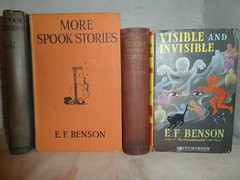
E F Benson presents a challenge since his best stories are scattered throughout the four volumes of ghost stories published in his lifetime. So, as with M R James, I chose the first. The title story concerns another vampire, but there are plenty of other types of hauntings, including a very strange telephone in 'The Confession of Charles Linkworth'.


Benson's best story, by some distance in my opinion, is 'The Face' contained in 'Spook Stories' (Hutchinson, 1928), in which the heroine opens her door not to the husband who is rushing to save her, but to the spectre who will lead her to her death.

'On the Edge', Walter de la Mare, Faber and Faber (1930)


De La Mare was considered by Julia Briggs, author of the excellent 'Night Visitors', one of the finest exponents of the ghost story and the title of this book perfectly encapsulates his technique. Ghosts are presented, if at all, obliquely with the reader struggling to rationalise what is behind the words. De La Mare was a poet and many of his narrative works have the form of prose poems, including even his full length ghostly novel 'The Return'.

There are other De La Mare collections with equally fine stories, but this volume is chosen for two of my favourite ghost stories.


'Crewe' is a tale told in the waiting room at Crewe Railway Station, well known to me in my youth and as dreary then as in the story. I also can now never look at a scarecrow without remembering this story's haunting image of a scarecrow slowly getting nearer to its victim. 'The Green Room', set in a bookshop, is never far from my mind on any of those rare occasions where a bookseller has, as with the hero of the story, introduced me into a back room where only 'choicer customers' are allowed. But I have never (at least not to my knowledge) met the resident ghost.

'We Are for the Dark', Robert Aickman and Elizabeth Jane Howard, Jonathan Cape (1951)


From De La Mare we are led naturally to the book now widely recognised as marking a new beginning for the ghost story - no more spectres lurking on the stairs, but a new look at the strangeness within and around us. Aickman published six further volumes of strange stories after this collaboration with the novelist Elizabeth Jane Howard. In this volume each author contributed three stories. The best of Howard's is 'Three Miles Up' set on a decidedly strange canal, both authors at the time being closely involved with the preservation of England's waterways. But pride of place must be awarded to 'The Trains', perhaps Aickman's finest story, in which two women walking in the moors of northern England take shelter at what turns out to be decidely the wrong sort of house. This is admittedly a hackneyed theme but Aickman's treatment is original and masterly and it is no surprise that he went on to be recognised as the best writer of strange stories in the second half of the twentieth century.

Most admirers of ghost stories would have made other choices for a list of 'best books', and I would love to have included Henry James, Edith Wharton and Mrs Oliphant, but no list can be infinite. Henry James would, in any event, be excluded since he himself did not publish a volume of ghost stories. 'The Ghostly Tales of Henry James', a superlative collection, was published many years after the author's death by his biographer Leon Edel and hence the selection made was not the result of a conscious choice made by James himself.

So, time to settle down with a good ghost story, but wait - who on earth can be knocking on the door at this time of night and just when did that wind get up so?


- Posted using BlogPress from my iPad

Saturday, 20 August 2011

Joseph Sheridan Le Fanu, Dublin's Prince of Darkness


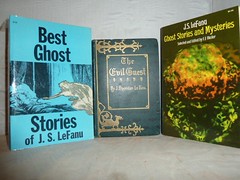
Those fortunate enough to have read the excellent anthology "Fifty Years of Ghost Stories" during childhood will have soon encountered two stories by J Sheridan Le Fanu, the man M R James considered the supreme writer of ghost stories - 'The Familiar' and 'Green Tea'. In the former, the unfortunate Captain Barton is pursued to his death in his own bedroom by a vengeful revenant; in the latter the Reverend Jennings is haunted by a monkey, the appearance of which is attributed to excessive consumption of green tea, and driven to suicide. Both are powerful stories and these alone would place Le Fanu high amongst writers of supernatural fiction.

However, add to these the unforgettable 'Carmilla', most frightening of all vampires, and 'Schalken the Painter', in which the terrified Rose Velderkaust, forced into marriage to a repulsive stranger by her uncle in return for a large dowry, returns from her wedding night to reveal she has been married to a dead man and Le Fanu is seen, as M R James noted, to be absolutely in the first rank of ghost story writers. I read most of these stories in 1960's in the Dover editions edited by E F Bleiler.


However, for those seeking Le Fanu's stories of the supernatural for the first time I would turn to the three volumes edited by Jim Rockhill and published by the Ash-Tree Press. In addition to forming a comprehensive set of the ghost stories, the Ash-Tree Press books are themselves beautifully produced and a delight to read and handle.


Le Fanu's powers as a ghost story writer reached their peak in "In a Glass Darkly", published in three volumes in 1872, the year before his death. This includes 'Green Tea', 'Carmilla' and, another of my favourites, 'Mr Justice Harbottle', in which a hanging judge is subjected to his own frightful supernatural judgement by one of his victims.


In addition to his short stories and minor writings Le Fanu wrote fourteen novels, the most celebrated being "Uncle Silas" and "The House by the Churchyard". As was customary for the time, the novels were generally first serialised in the popular magazines - "All the Year Round", "Dublin University Magazine", "Temple Bar".


"Uncle Silas" picks up a recurring theme in Le Fanu - vulnerable young women entrusted to the care of people who wish them harm by (not always) well-intentioned fathers, mothers or brothers. In "Uncle Silas", it is her dying father who, seeking to be reconciled with his estranged brother, passes Maud Ruthyn into the 'care' of her uncle, who plots her murder in order to inherit her fortune. In "Checkmate" it is Alice Arden's brother who attempts to force her into marriage with the villainous Mr. Longcluse. However, the ultimate betrayal is found in my personal favourite - "The Rose and the Key", in which it is her own mother who commits Maud Vernon to an asylum, again in pursuit of her daughter's fortune. The tension mounts remorselessly as Maud slowly realizes that the country house she thought she was visiting is, in fact, a lunatic asylum and sees her desperate attempts to escape taken as further proof of her madness.


The original three volume editions of the novels are now impossibly scarce and, commensurate with their rarity, very costly. I do have the first two volumes of "The Tenants of Malory" and that, I fear is as close as I will get.


However, single volume editions published later in the nineteenth century can be found and those published by Downey and Company form a particularly attractive set.


New editions of other novels also appear from time to time, sometimes under Irish press imprints.


A set of Collected Works in 51 volumes was produced by the Arno Press of New York in 1977, but to date I have only located two of the three volume novels, both ex University of Arizona.

Paperback editions of the more popular novels and short stories have been produced in recent years by, amongst others, Alan Sutton, Nonsuch Publishing and Wordsworth Editions.


"The House by the Churchyard" is justly famous, not only for its complex plot and wonderful evocation of Chapelizod, but also for the fact that the young James Joyce found a copy of the book in his father's library and later used elements of its plot and descriptions in "Finnegans Wake". In Le Fanu's work a crime is committed in Phoenix Park and this is mirrored in "Finnegans Wake" by Earwicker's encounter with the two women at the same location, which event brings about his fall and loss of reputation.

In addition, there are three references to "The House by the Churchyard" in the Wake that show how much Joyce admired Le Fanu's novel; these appear as 'Lefanu (Sheridan's) Old House by the Coachyard', 'The old house by the churpelizod' and (in Dutch) 'De oud huis bij de kerkegaard'. Having stood outside the house in Chapelizod, which was the inspiration for Le Fanu's work, on a cold grey December afternoon, I can well imagine what ghosts the building conjured up in the author's mind.


It was M R James in 1923, who cemented Le Fanu's reputation by his editorship of "Madame Crowl's Ghost and other Tales of Mystery", to which he added a useful prologue and an excellent bibliography. MRJ also contributed the introduction to the OUP World's Classics edition of "Uncle Silas". In recent years there has been a welcome increased interest in Le Fanu, spearheaded by Brian J Showers at the Swan River Press, Gary W Crawford via the on-line journal "Le Fanu Studies" and Jim Rockhill.

Le Fanu, the son of a Church of Ireland priest was born in 1814 in Dublin, where he spent much of his life - from 1856 to his death in 1873 living in No. 70 on the fashionable Merrion Square.


From 1861 he edited the Dublin University Magazine, in which many of his works first appeared and to which he began contributing in 1838, with the short story 'The Ghost and the Bonesetter'. Affected by the early death of his wife, Le Fanu was attracted to the writings of the Swedish philosopher Swedenborg, whose visions of Heaven and Hell may have influenced Le Fanu's work. Indeed, the popular image of the mature Le Fanu is of a tormented recluse emerging from his house on Merrion Square late at night to wander the streets of Dublin, pursued by the phantoms of his own nightmares. This does not quite square with the life of a busy editor and man of letters, but I do like to think that Le Fanu's ghost still paces the silent city streets deep into the night when all human traffic has ceased. And even in broad daylight, I have felt a shiver when walking along Aungier Street and remembering the 'strange disturbances' that afflicted a house on that Dublin street in Le Fanu's story.


- Posted using BlogPress from my iPad

Sunday, 10 April 2011

Bookplates and the DIspersed Library

Unless you are a Samuel Pepys or Thomas Jefferson then it is almost inevitable that, however fine your library, there will come a day when it will be divided, sold, given away or otherwise dispersed. This is not necessarily a bad thing, since out of the debris of once coherent collections emerge new private libraries and new material for the great public collections. It is an endless recycling that is the wellspring of the collector's joy as long sought after books appear at auction, in bookshops and on on-line book sites.

Many collectors mark their books in some way to identify their ownership. This may be by a simple signature, or by the inclusion of a personal bookplate normally affixed to the front pastedown. First edition fetishists may recoil in horror at the thought of an otherwise pristine copy being defaced in this way, but to a true booklover such symbols of ownership become a new trail to explore. They also make a tangible connection between you and that other owner - you have both handled (and hopefully read) this very copy.

Over the course of our collecting life, both by chance and design, many books with interesting bookplates, or other signs of ownership, have found their way onto the shelves. Here is a sample:


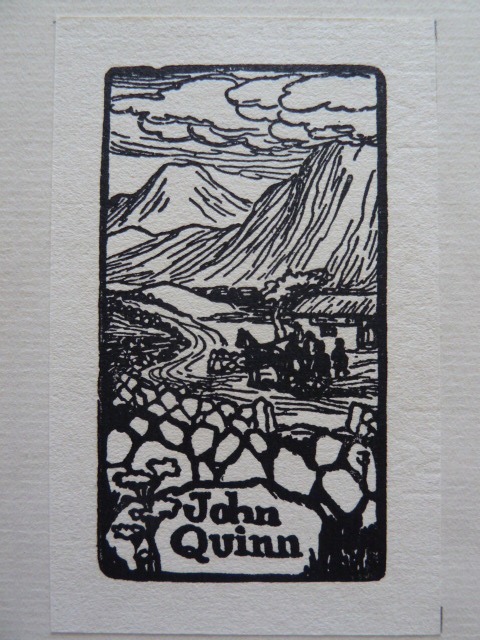
The bookplate of John Quinn in Arthur Machen's "The Three Imposters" (John Lane, 1895). This bookplate was designed for Quinn by Jack Butler Yeats. Quinn was an American lawyer and eminent collector of modernist works. He was a patron of many literary figures, including W B Yeats, Ezra Pound and James Joyce, from whom he puchased the manuscript of "Ulysses" (now in the Rosenbach Museum, Philadelphia). Quinn also successfully defended Joyce's "Ulysses" against obscenity charges. So, I now have in my hand a book from a collection that contained the manuscript of "Ulysses". Could it get much better?


The bookplate of novelist Dennis Wheatley in Forrest Reid's "Walter de la Mare: A Critical Study" (Faber and Gwyer, 1929). Wheatley's library was sold by Blackwell's in 1979 and this was Item 1806 in their catalogue.


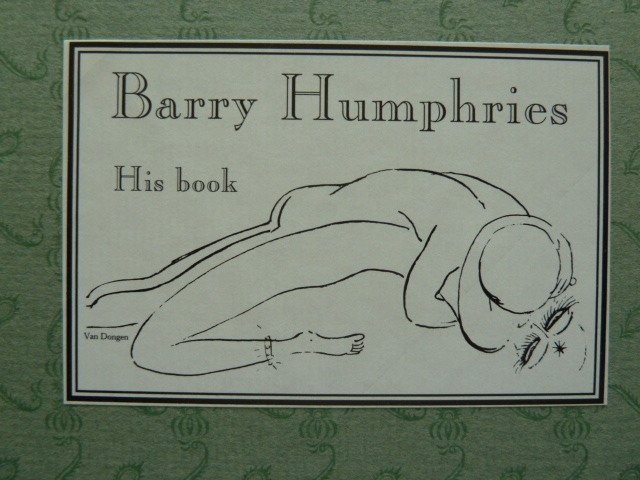
The bookplate of comedian Barry Humphries in Arthur Machen's "Ornaments in Jade" (Alfred A Knopf, 1924).


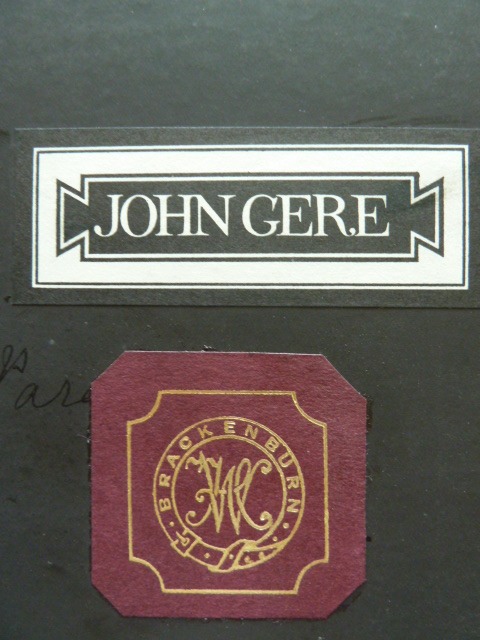
Two for the price of one - the bookplate of novelist Hugh Walpole's Brackenburn Library and that of art historian and curator John Gere in J Sheridan Le Fanu's "Wylder's Hand (Hutchinson, no date). A pencil note by Gere says that this copy was purchased at the Christie's sale of Walpole's library on 11/2/46.


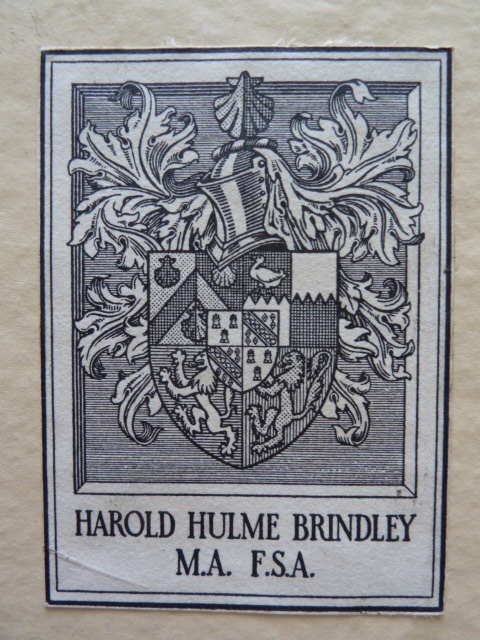
The bookplate of Harold Hulme Brindley, naturalist, in M R James' "Ghost Stories of an Antiquary" (Edward Arnold, 1904). Brindley knew James at Cambridge and this copy contains a manuscript letter from MRJ to Brindley as well as illustrations of the scenes in the stories pasted into the book by Brindley, making it a very special copy - far from a pristine first but infinitely more interesting.


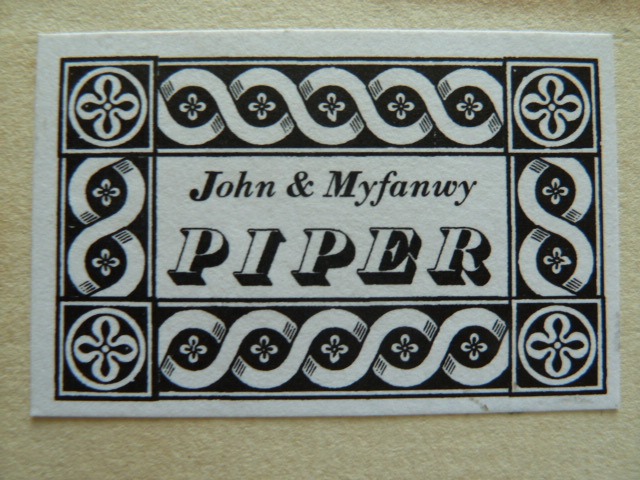
The bookplate of John and Myfanwy Piper in John Ruskin's "Modern Painters" (George Allen, 1888).


The bookplate of Isambard Brunel (son of the engineer) in John Ruskin's "Stones of Venice" (Smith Elder, 1851)


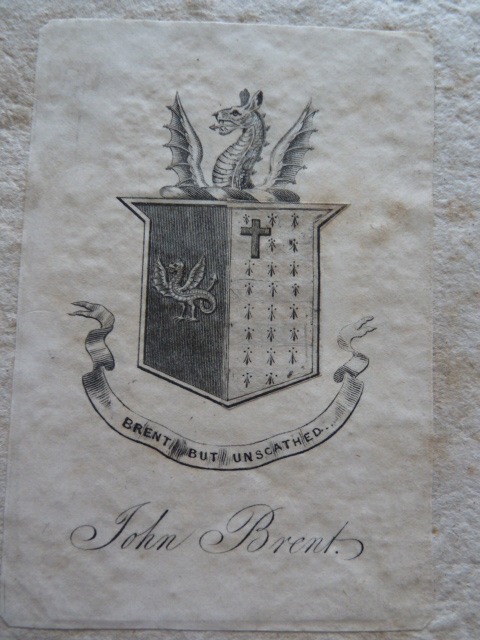
The bookplate of John Brent, antiquary and novelist in Henry Rowlands' "Mona Antiqua Restaurata" (Dublin, 1723).


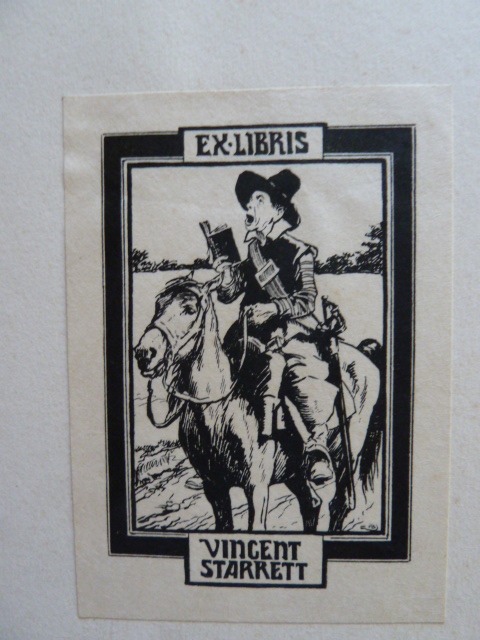
The bookplate of Vincent Starrett, bibliophile, author and Sherlock Holmes afficionado, in his own book "Penny Wise and Pound Foolish" (New York 1929). This bookplate was designed by the illustrator Gordon Browne (son of H K Browne ('Phiz')).


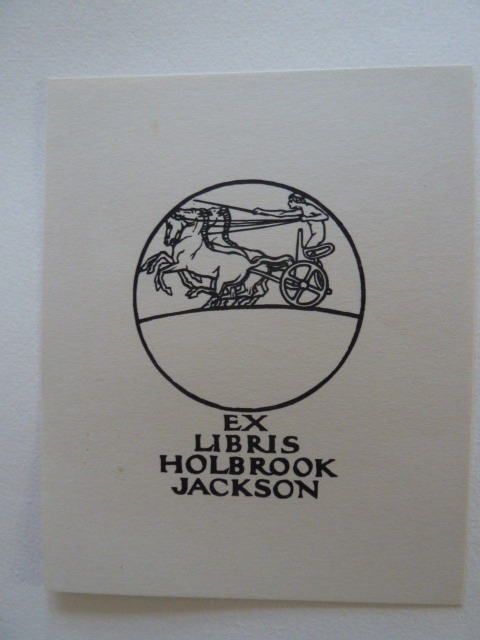
The bookplate of bibliophile, collector and writer about books, Holbrook Jackson, loosely inserted in the copy of James Joyce's "Storiella as She is Syung" (Corvinus Press, 1937), presented by the owner of the press, Viscount Carlow, to Jackson when he visited the press on 12th April 1938. Interestingly, Viscount Carlow has written a suitable presentation inscription to Jackson in ink on a preliminary blank page, but Jackson, perhaps in deference to the beauty of the book, did not paste in his bookplate.


John Ruskin's Brantwood bookplate in Mrs Oliphant's "The Makers of Florence" (Macmillan 1877). Care is needed with Ruskin bookplates since, after the dispersal of his library, it is almost certain that some bookplates purporting to be Ruskin's were printed and inserted in books not from his library to increase their value. The story is told in James Dearden's "Facets of Ruskin". The example shown dates from circa 1890 and probably indicates Ruskin ownership of this book.

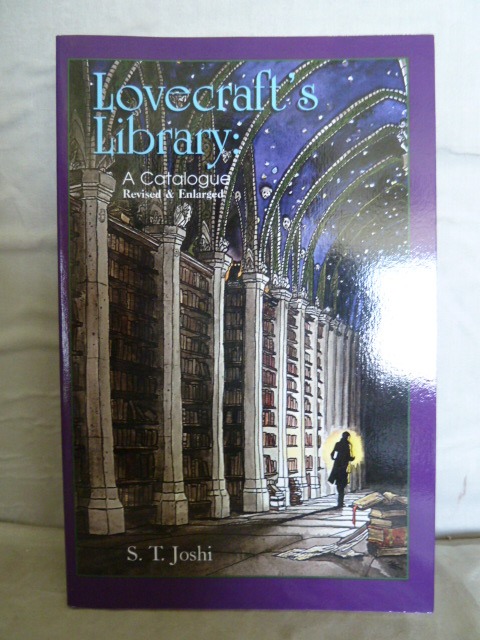
It has become a standard exercise now to try to compile lists of books in authors' libraries long dispersed. In our collection we have books with such lists for James Joyce's Trieste library, Ruskin's library, Lewis Carrol's library and H P Lovecraft's library.


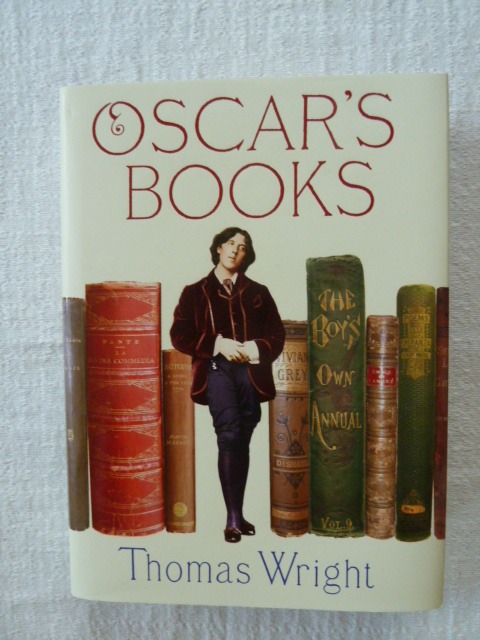
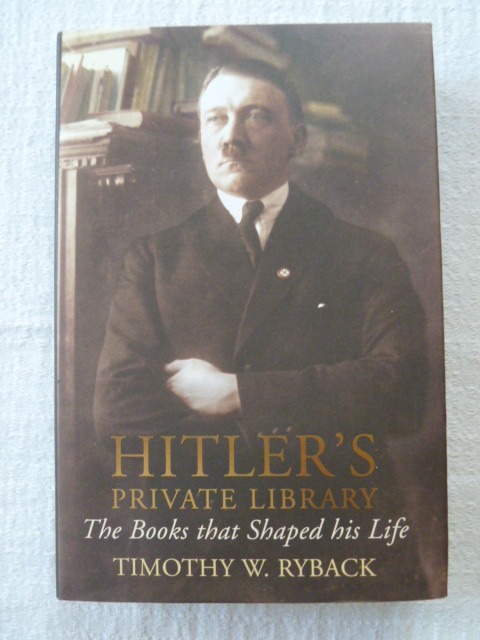
There are recent books on Oscar Wilde's library and even Hitler's private library.


It was in Peter L Stern's superb bookshop in Boston that I had in my hand H P Lovecraft's copy of M R James' "A Thin Ghost and Others" with both Lovecraft's bookplate and his signature. Sadly I replaced it on the shelf to await another traveller in the realms of phantom libraries, or, to be perfectly honest, we couldn't afford it.


- Posted using BlogPress from my iPad

Wednesday, 8 December 2010

Pleasure in Being Frightened

When I was a child we lived in an old farmhouse with dark corridors leading to bedrooms rarely visited. Having two older brothers it is not surprising that I was introduced to stories of ghosts and witches at an early age. The most terrifying room, however, was the sitting room, only used for social events, that lay at the far end of the house from the parlour, where we spent most of our time. Even on a warm summer day, I did not care to linger there. But the frisson of fear was never altogether unpleasant and it is to these apparently harmless childhood terrors that I attribute my love of ghost stories.

The first ghost story I remember was read to us by our live-in land girl, one night when my brother and I had just been put to bed. With hindsight, A E D Smith's 'The Coat', in which an old moth-eaten greatcoat, first seen hanging from a coat hook, attempts to strangle an unwary visitor to an uninhabited house with it's horribly flapping empty arms, may not seem the most suitable night-time reading for 6 year olds, but it is the only bed-time story from that period that I actually remember. Years later, I found the story again in 'The Mammoth Book of Thrillers, Ghosts and Mysteries', in a part of the book invitingly called 'Sealed Section'. The coat belonged to a disreputable person who had been shot when wearing it and now apparently waits in the house for those staple ghost story characters who know something's wrong but still persist in invoking any malevolent spirit in the area.
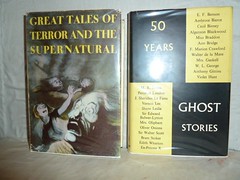
Since then there has rarely been a period of my reading life in which ghost stories have not been close at hand. At first it was through anthologies, such as the superb collection 'Fifty Years of Ghost Stories', in which I first read M R James and Sheridan Le Fanu, both of whose stories are just as fresh 50 years later.


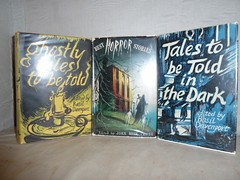
There were also the excellent Faber and Faber collections 'Best Horror Stories', with it's wonderful Felix Kelly dust wrapper, and 'Best Ghost Stories', followed by Basil Davenport's anthologies 'Ghostly Tales To Be Told' and 'Tales To Be Told In The Dark'. It was in these latter collections that I first read Arthur Machen.


Once I had read the massive Wise and Fraser anthology 'Great Tales of Terror and the Supernatural' and Montague Summers' 'Supernatural Omnibus', I was in a position to sort out the great writers from the merely competent. I also began slowly to search out the original volumes by these authors from which their stories had been drawn by the anthologists.

So, who are these great authors and what are the key books that constitute a ghost story collection?

Most, myself included, would place M R James at the head of the list. His four volumes 'Ghost Stories of an Antiquary', 'More Ghost Stories', 'A Thin Ghost and Others' and 'A Warning to the Curious and Other Ghost Stories' were published between 1904 and 1926 and define what has come to be known as the antiquarian or scholarly ghost story. Oblivious to warning signs that are blindingly obvious to the reader, M R James's typical hero, pursuing his antiquarian interests will insist on provoking the malevolent entity that will either finish him off in a particularly nasty way or guarantee him (and us) future nightmares and other unpleasant moments.


As to what are the best stories from the 30 or so written by MRJ, strong claims may be made for 'Oh Whistle and I'll Come to You My Lad', from the first of the four volumes (published in 1904) and 'Casting the Runes', from the next volume (1911). I do have a particular fondness for the superbly titled 'The Tractate Middoth', from 'More Ghost Stories', partly because most of the action takes place in a library, which I assume to be the Fitzwilliam. It is the removal of the book of the title from the library that precipitates the rather nasty revenge taken on the borrower, when a 'little dark form' rises out of the shadow behind a tree trunk and two arms emerge to cover his face in a 'mass of blackness'. Those staple trappings of ghost stories, cobwebs and spiders, feature prominently in this story.


E F Benson, like M R James, produced four excellent volumes of ghost stories, beginning with 'The Room in the Tower' in 1912, followed by 'Visible and Invisible', 'Spook Stories' and 'More Spook Stories' (1934). Though variable in quality, there is much to enjoy here, my own favourites being 'The Face' and 'Pirates', both much anthologized. In the latter story, a middle-aged man purchases the house of his childhood, long deserted, and restores it to its former state when he and his brothers and sisters, now all dead, used to play in the garden. Living more and more in the past, he finally joins the phantom children in a game of Pirates and is found dead the next morning. The ghosts in this story are the ghosts of childhood; it is significant that the house had been re-furnished with much of it's original furniture, returned to the house after some 40 years. This re-creation of the past brings back the former inhabitants of the house. Or is it all down to an over-active imagination and a weak heart? As with all the best ghost stories, there are several possible interpretations.


Ghosts of children, or ghosts haunting children, are plentiful, from the vengeful children with the fearfully long finger-nails, who return to tear the heart out of the unfortunate Mr Abney, in M R James' 'Lost Hearts', to little Miles and Flora, corrupted by the ghosts of their former governess and her lover, in 'The Turn of the Screw', or again is the whole nightmare visited on the children by their paranoid new governess, the un-named young lady who narrates the story?

It is time to introduce the third of the writers who, to me, define the English Ghost Story. This is, paradoxically, an Irishman, Joseph Sheridan Le Fanu, who, along with his admirer, James Joyce, is associated in my mind with Dublin in a way that no other city or writer is. Whenever in Dublin, I stand outside the house on Merrion Square from which Le Fanu emerged for his nocturnal walks round Dublin and in which he is supposed to have succumbed to his final nightmare. Walking the lonelier streets of Dublin, I listen for the following phantom footsteps that pursued Captain Barton to his terrifying end in 'The Familiar' and in a quieter section of Aungier Street, I observe a deserted house with grass and small trees growing from the roof that I would like to have been the setting for Le Fanu's short tale 'An Account of Some Strange Disturbances in Aungier Street'. This short topographical tour of Le Fanu's Dublin must end outside the much haunted 'House by the Churchyard' in Chapelizod, the setting for the Le Fanu novel so admired by James Joyce and one of the influences on his 'book of the dark', 'Finnegans Wake'.


There are many excellent stories by Le Fanu, collated originally from the magazines of the period by M J James in 'Madame Crowl's Ghost and Other Tales of Mystery' (1923), but it is to 'In a Glass Darkly' (1872) that we must turn for what I consider to be the finest ghost stories of the nineteenth century. As well as 'The Familiar' and the justly celebrated 'Green Tea', we are introduced in this volume to the most terrifying vampire in literature, the wonderful Carmilla, immortalised for all the wrong reasons by the late Ingrid Pitt in the lurid and explicit film 'The Phantom Lovers'. It is worth quoting in full the last sentence of 'Carmilla':

"It was long before the terror of recent events subsided; and to this hour the image of Carmilla returns to memory with ambiguous alternations- sometimes the playful, languid, beautiful girl; sometimes the writhing fiend I saw in the ruined church; and often from a reverie I have started, fancying I heard the light step of Carmilla at the drawing-room door"

To my mind the last phrase of this sentence captures the essence of the ghost story; it is in our unguarded moments that the phantoms of our own past as well of those of literature return to surprise us and, I sincerely hope, cause us not a few unpleasant moments.


I will end this all too brief survey with a personal selection - eleven of my favourite ghost stories, restricted to one per author. These are given in chronological order of publication.

'The Old Nurse's Story', Mrs Gaskell (1852)
'Mr Justice Harbottle', J Sheridan Le Fanu (1872)
'Oke of Okehurst', Vernon Lee (1890)
'The Turn of the Screw', Henry James (1898)
'Man Overboard', F Marion Crawford (1903)
'Afterward', Edith Wharton (1910)
'The Green Room', Walter de la Mare (1925)
'A Warning to the Curious', M R James (1926)
'The Face', E F Benson (1928)
'The Rosewood Door', Oliver Onions (1929)
'The Sweeper', X Private X (1931)

If not one of these stories makes you unwilling to look back as you turn the lights off when leaving an empty room on a dark night as the wind moans in the trees, then maybe ghost stories are not for you.

It has often been said that the ghosts of the nineteenth and early twentieth century did not survive in the era of electric lights and motor cars. This is only partly true; there are many modern writers who have maintained the traditions of the 'Golden Age' of the ghost story. In a later blog, I will turn my attention to some of these later practitioners of the art.


- Posted using BlogPress from my iPad