Showing posts with label J Sheridan Le Fanu. Show all posts

Wednesday, 2 January 2013

The Best Ghost Story Collections


Winter is the season of ghosts, as doors rattle and creak in the wind and bare limbs of trees tap at the window pane. It is a time to huddle round the fire with a good book and what better reading could there be than a ghost story? It was a tradition when I was young to choose a volume of ghost stories for a Christmas present and that tradition to some extent lingers with me still, made easier nowadays by the collections published by the excellent supernatural small presses such as Ash-Tree Press, Tartarus Press and Swan River Press, not to mention the copious volumes reprinted by Wordsworth Editions in their 'Tales of Mystery and the Supernatural' series.

However, for all the ghost stories written, there are a surprisingly small number of books of ghost stories that can be considered truly great, and here I mean books by a single author, not anthologies with multiple authors (which I will cover at a future time).

Over the years, some of these books have found their place in the High Barn Library and I have chosen just nine, with one exception spanning the 60 or so years between 1872 and 1930, during which period the literary and psychological ghost story forms reached their zenith.

'In a Glass Darkly', J Sheridan Le Fanu, Richard Bentley (1872)


In this outstanding volume, Le Fanu probes the boundary between the supernatural and the psychological, particularly in 'Green Tea', one of the most anthologised of ghost stories, in which the unlucky Revd. Jennings is haunted by a green monkey. Other oustanding stories are 'The Familiar', 'Carmilla', with its lovely but deadly vampire, and 'Mr Justice Harbottle', the hanging judge who receives his death sentence from a terrifying supernatural court. Le Fanu wrote many other ghost stories, but it is in this volume that his powers are fully realised.

'Hauntings: Fantastic Stories", Vernon Lee, Heinemann (1890)


The lyrical prose and beautiful topographical descriptions in these four stories add considerably to the supernatural content. The author is equally at home in the Venice of 'A Wicked Voice' as in the Kentish countryside of 'Oke of Okehurst'. Montague Summers justly praised her genius in his excellent introduction to 'The Supernatural Omnibus', including two of these stories in that volume.

'Ghost Stories of an Antiquary', M R James, Edward Arnold (1904)


There is a problem here about which of the four collections of ghost stories written by M R James to include. My heart is perhaps with the second collection 'More Ghost Stories' (1911) containing 'Casting the Runes' and 'The Tractate Middoth', the first volume of James I encountered, aged about 10. However, with the head I have to select the first he published, which includes the incomparable 'Oh, Whistle, and I'll Come to You, My Lad', not to mention 'Count Magnus', 'Lost Hearts' and 'The Ash-Tree'.


This was the only of his first editions to be illustrated and the drawings of James McBryde (who died before its publication) add considerably to the book. In these stories we are shown the dangers inherent in raising the spirits of the dead and that too much intellectual curiosity can be a decidely dangerous thing.

'John Silence, Physician Extraordinary', Algernon Blackwood, Eveleigh Nash (1908)


I do not normally like stories involving supernatural sleuths, but Dr. John Silence is different and in the best of the five stories in this volume is an inconsequential figure. These are predominantly, as in much of Blackwood's ghost (or, more correctly weird) stories, studies of the influence of place on susceptible minds. From the sleepy northern French town of 'Ancient Sorceries' with its supernatural cats to the mysterious brotherhood in the sleepy southern German town of 'Secret Worship' and on to the Scandinavian islands of 'The Camp of the Dog', we follow Blackwood's susceptible travellers as they encounter forces beyond normal experience.

'Widdershins', Oliver Onions, Martin Secker (1911)


Oliver Onions wrote much besides ghost stories and those in this volume are of uneven quality, but the book is included chiefly on account of 'The Beckoning Fair One', one of the best long ghost stories ever written, in which the dangers of renting buildings long unoccupied are fully realised.

'Uncanny Tales', F Marion Crawford, Tauchnitz Edition (1911)


F Marion Crawford is the only American author in my list and is not chiefly remembered now for his ghost stories. However, I read 'Man Overboard!' at an early age and, as a story of ghostly revenge it has seldom been bettered. Also in this volume are the much anthologised 'The Upper Berth', the vampire tale 'For the Blood is the Life' and 'The Screaming Skull' based on a legend concerning a Dorsetshire farmhouse.

'The Room in the Tower', E F Benson, Mills & Boon (1912)


E F Benson presents a challenge since his best stories are scattered throughout the four volumes of ghost stories published in his lifetime. So, as with M R James, I chose the first. The title story concerns another vampire, but there are plenty of other types of hauntings, including a very strange telephone in 'The Confession of Charles Linkworth'.


Benson's best story, by some distance in my opinion, is 'The Face' contained in 'Spook Stories' (Hutchinson, 1928), in which the heroine opens her door not to the husband who is rushing to save her, but to the spectre who will lead her to her death.

'On the Edge', Walter de la Mare, Faber and Faber (1930)


De La Mare was considered by Julia Briggs, author of the excellent 'Night Visitors', one of the finest exponents of the ghost story and the title of this book perfectly encapsulates his technique. Ghosts are presented, if at all, obliquely with the reader struggling to rationalise what is behind the words. De La Mare was a poet and many of his narrative works have the form of prose poems, including even his full length ghostly novel 'The Return'.

There are other De La Mare collections with equally fine stories, but this volume is chosen for two of my favourite ghost stories.


'Crewe' is a tale told in the waiting room at Crewe Railway Station, well known to me in my youth and as dreary then as in the story. I also can now never look at a scarecrow without remembering this story's haunting image of a scarecrow slowly getting nearer to its victim. 'The Green Room', set in a bookshop, is never far from my mind on any of those rare occasions where a bookseller has, as with the hero of the story, introduced me into a back room where only 'choicer customers' are allowed. But I have never (at least not to my knowledge) met the resident ghost.

'We Are for the Dark', Robert Aickman and Elizabeth Jane Howard, Jonathan Cape (1951)


From De La Mare we are led naturally to the book now widely recognised as marking a new beginning for the ghost story - no more spectres lurking on the stairs, but a new look at the strangeness within and around us. Aickman published six further volumes of strange stories after this collaboration with the novelist Elizabeth Jane Howard. In this volume each author contributed three stories. The best of Howard's is 'Three Miles Up' set on a decidedly strange canal, both authors at the time being closely involved with the preservation of England's waterways. But pride of place must be awarded to 'The Trains', perhaps Aickman's finest story, in which two women walking in the moors of northern England take shelter at what turns out to be decidely the wrong sort of house. This is admittedly a hackneyed theme but Aickman's treatment is original and masterly and it is no surprise that he went on to be recognised as the best writer of strange stories in the second half of the twentieth century.

Most admirers of ghost stories would have made other choices for a list of 'best books', and I would love to have included Henry James, Edith Wharton and Mrs Oliphant, but no list can be infinite. Henry James would, in any event, be excluded since he himself did not publish a volume of ghost stories. 'The Ghostly Tales of Henry James', a superlative collection, was published many years after the author's death by his biographer Leon Edel and hence the selection made was not the result of a conscious choice made by James himself.

So, time to settle down with a good ghost story, but wait - who on earth can be knocking on the door at this time of night and just when did that wind get up so?


- Posted using BlogPress from my iPad

Friday, 11 November 2011

Felix Kelly: Visions of Haunted Houses

One of the joys of book-collecting is that new categories emerge within the collection without any initial intent to create that category. Surreptitiously, a new group of related books appears and initiates a new interest.

So it was with Felix Kelly, at first just a name identifying him as the illustrator of the dust jacket of Faber and Faber's "Best Horror Stories" (1957). I first encountered this volume in its year of publication and, with its suitably ghostly picture of a wraith-like figure with a skeleton in its arms outside a deserted house, it immediately puts you in the world of M R James.
Some time later two more Felix Kelly dust jackets turned up, again in Faber and Faber's series of "Best of ..." collections. These were "Best Tales of Terror" (1962) and "Best Detective Stories" (1959), both edited by Edmund Crispin and again both suitably menacing with threatening figures appearing out of the dark.
Perhaps, though, the definitive Felix Kelly ghostly image is that making up the wrap-around dust jacket of Joseph Braddock's "Haunted Houses", (Batsford 1956). Here, trade-mark wraiths glide between gothic mansions in a landscape of tombstones and bare trees. Particularly effective is how the title of the book is placed on a white shroud (?) hanging over the scene.
Two more dust jackets complete this collection, both published by Home and Van Thal. That of Rhoda Broughton's "Twilight Stories" (1947) is set within an architectural drawing of a decaying window and has the usual leafless tree and gravestones as backdrop to the solitary figure.
"A Strange Adventure in the Life of Miss Laura Mildmay" (J Sheridan Le Fanu, 1947) again features gravestones, towards which a female figure is falling as ominous black birds approach out of a lurid sky.
Felix Kelly (1914-1994) was a New Zealander, born in Auckland, who came to live permanently in England from 1935, serving as a fighter pilot in World War II. He is often compared with Rex Whistler and, like Whistler, made something of a speciality of decorating country houses with murals, often depicting imagined romantic landscapes replete with ruins in the manor of Claude. In pursuit of this career he was friendly with many aristocratic families, in the eighties working for Prince Charles at Highgrove.

Perhaps his most famous murals are those in the Garden Hall at Castle Howard, which he painted for Granada TV, under the patronage of the Howard family, for "Brideshead Revisited". It is these murals, depicting imagined Vanbrugh buildings, with features from Castle Howard, that Jeremy Irons, in the character of Charles Ryder, is seen painting in the series. Indeed there are so many parallels between the career of Kelly and the fictional Ryder, that the former's character may well have been used by Evelyn Waugh as the model for Charles Ryder.

The actors Jeremy Irons and Anthony Andrews are seen in the Garden Hall below:
A Kelly painting of the station at Castle Howard, painted for the Howard family:
As an artist, Kelly incorporates surrealist elements, but is chiefly associated with the Neo-Romantics. Some other typical works:

Kelly's childhood remembered in this surreal image of Takapuna Beach, near Auckland:
Mural for the Banqueting Hall, the Royal Palace, Kathmundu, Nepal:
Disturbing image with Kelly-esque woman in a black cloak:
A monograph on Kelly (known to friends as "Fix")was published in 2007 by Donald Bassett, an art historian at the University of Auckland, accompanying an exhibition (A Kiwi at Brideshead) of his work.
Felix Kelly illustrated many books, some with superb dust jacket designs, but, for me, it will always be his haunted houses decorating the dust jackets of some of my favourite books that retain their hold on my imagination.

Wednesday, 28 September 2011

"not yet, though vennisoon after" - when to read 'Finnegans Wake'


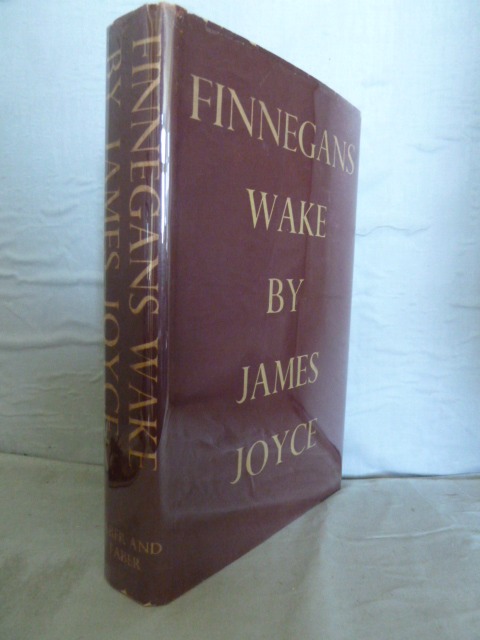
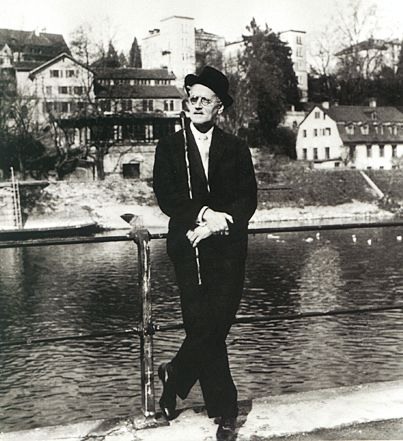
It is a truth universally acknowledged that, for all except a select band of devotees, in 'Finnegans Wake' James Joyce bequeathed as his parting gift to the world a book that is essentially unreadable. Yet any list of the world's great books would include Joyce's 'book of the dark' alongside his book of the day, "Ulysses". To its admirers it is the greatest book of the twentieth century; to others it remains a mystery as yet unexplored.


It is complex, deliberately made so, as Joyce expanded and revised earlier drafts, creating ever richer neologisms and portmanteau words and incorporating words from a variety of languages. It is the multiplicity of meanings and interpretations contained in each phrase (and often word) that makes 'Finnegans Wake' the magical work it is. This, in turn, has led to a veritable industry of commentators, annotators and critics who have subjected the book to possibly the most detailed examination ever accorded to a modern work of fiction.


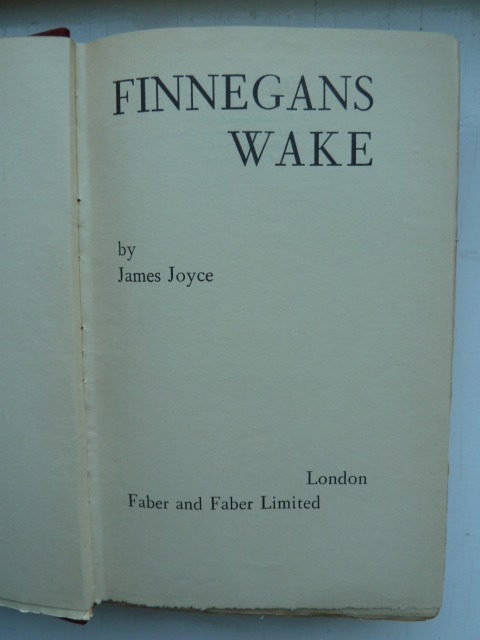
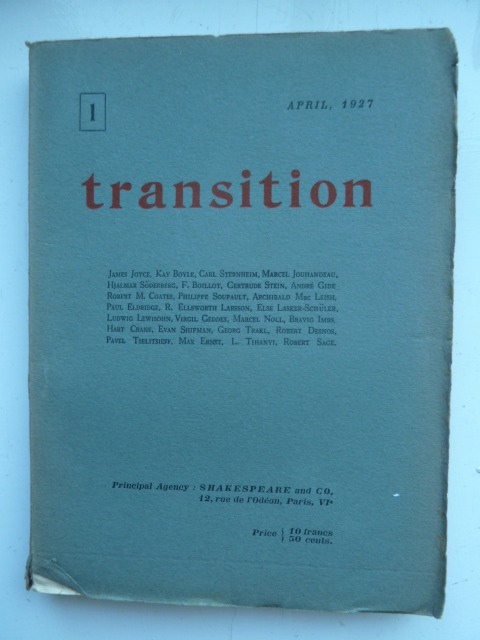
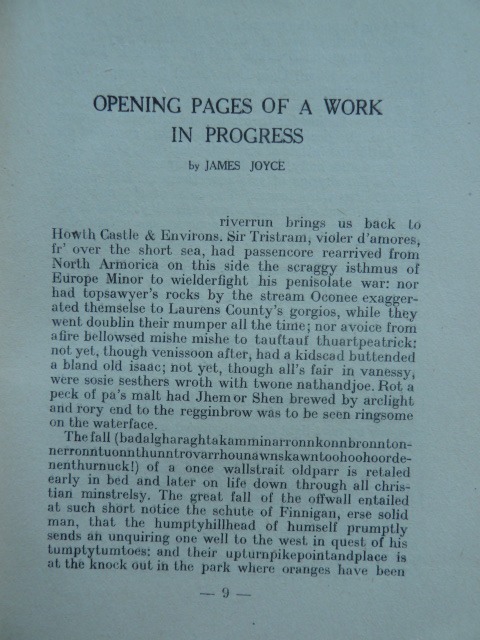
This process began even before the book was published in its final form by Faber and Faber in 1939, as a result of the publication in the journal 'Transition' of extracts from what was then called 'Work in Progress'.


These extracts in fact comprise the bulk of the work and were published in 17 installments between April 1927 and May 1938, Joyce having commenced his 'Work in Progress' in 1923, the year after 'Ulysses' was published. 'Transition', published by Sylvia Beach's Shakespeare and Company contained alongside 'Work in Progress', work by other leading modernists, such as Gertrude Stein, Marcel Duchamp, Kurt Schwitters and even Franz Kafka.


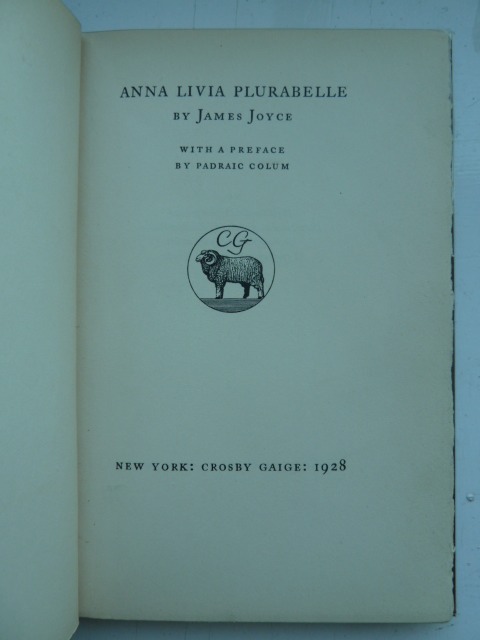
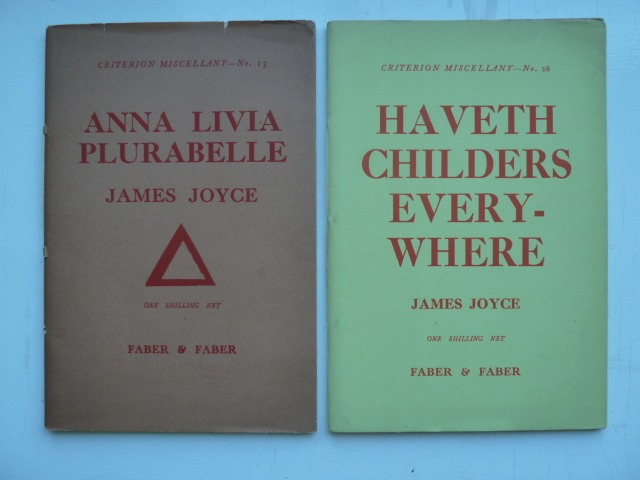
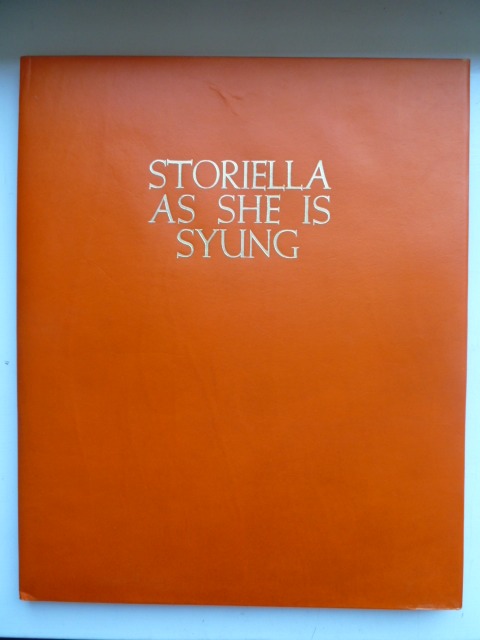
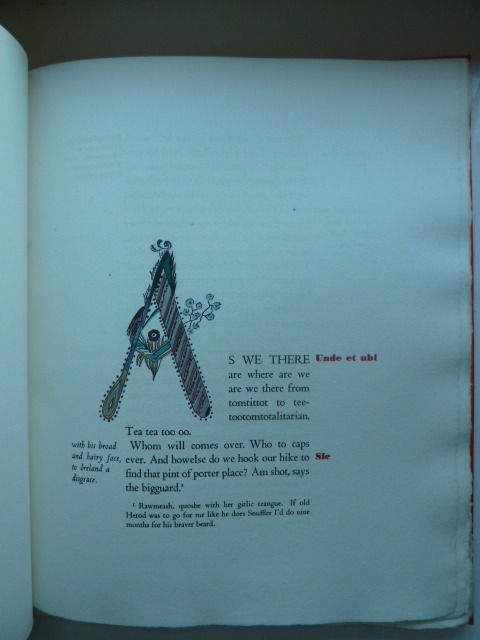
Sections of the work were also published in individual booklets by private presses, such as the Paris based Black Sun Press and the New York Crosby Gaige. Copies of these, especially the signed ones, can be very expensive. The first of these was 'Anna Livia Plurabelle' (1928), the last (and most elaborate, including a hand coloured initial letter by Joyce's daughter, Lucia) 'Storiella as She is Syung' (1938).


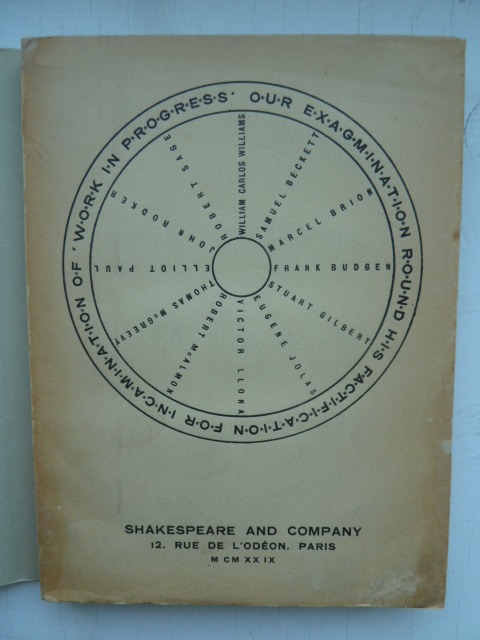
Only two years after the first appearance of 'Work in Progress' in 'Transition' Joyce encouraged a group of friends to publish their responses to it. Thus it was that in 1929, Shakespeare and Company published 'Our Exagmination Round his Factification for Incamination of Work in Progress', containing articles by, amongst others, Samuel Beckett (to whom Joyce dictated parts of 'Work in Progress' as his eyesight failed) and William Carlos Williams, surely the only occasion on which a spirited defence of a book has been published ten years before the actual book was published. A significant number of Joyce's letters to his friends also contain explanations of various parts of his text.


But then everything about 'Finnegans Wake' defies the usual conventions; it is one of those works like 'Tristram Shandy' and 'Alice's Adventures in Wonderland' that changes the landscape of literature. For a start, since its original publication, successive editions have maintained essentially the same pagination, from Page 3 through to 628, enabling references in critical works to page and line numbers to have universal application. This is similar to the Bible, with its generic Book, Chapter, Verse references and, in my mind, 'Finnegans Wake' is Joyce's sacred book, since into it he poured not only his own life experience, but a view of life that is both universally valid and profoundly sympathetic. Joyce's writing style, in this work, has all the characteristics of a dream, with characters undergoing transformations both to heroic archetypes and to geographical features. But the identity of the dreamer is not certain.

Who are the characters? Essentially a family living in a public house in Chapelizod, on the banks of the Liffey west of the centre of Dublin, at which house, a party has assembled for the wake of one Finnegan, a builder who fell from a ladder. The family are the publican, Humphrey Chimpden Earwicker (HCE), his wife Anna Livia Plurabelle, their twin sons Shem and Shaun and daughter Issy. But these characters represent all of humanity.

HCE is the archetypal flawed man, who has committed some sort of indiscretion in Phoenix Park, from which event much of the book's narrative action (such as it is) is derived. But he is also the mythical hero of his race, Finn MacCool, and a builder of cities and civilisations. His geographical counterpart is Howth Head, where the Liffey meets the Atlantic.

Anna Livia is all women and has her counterpart in the 'rivering waters of, hitherandthithering waters of' the River Liffey, Dublin's passage to the sea. She is a subject of gossip amongst the washerwomen down at the river but is the well spring of all life.

Shem 'the Penman' is the writer and artist (possibly Joyce), Shaun 'the Post' is the practical son (possibly Joyce's brother Stanislaus), deliverer of messages, while the lively Issy is every daughter.

Through these characters in their multiple avatars Joyce presents a view of all history, geography and literature. Finnegan's fall is Earwicker's fall is humanity's fall. Joyce was Influenced by the Italian philosopher Vico's theory of history as repeating cycles (successive ages of gods, heroes and humans followed by a period of chaos before the cycle repeats) and this cyclical pattern occurs thoughout the book, evidenced also by the first sentence of the book being the continuation of its final sentence.

I (perhaps like many others) read selected parts of 'Finnegans Wake' before attempting the whole book (which I have now done). To help I assembled a collection of, what have become standard 'companions' to the 'Wake'. Perhaps the best known of these is 'A Skeleton Key to Finnegans Wake' by Campbell and Robinson (1944), which contains analysis and a paraphrase of its text.


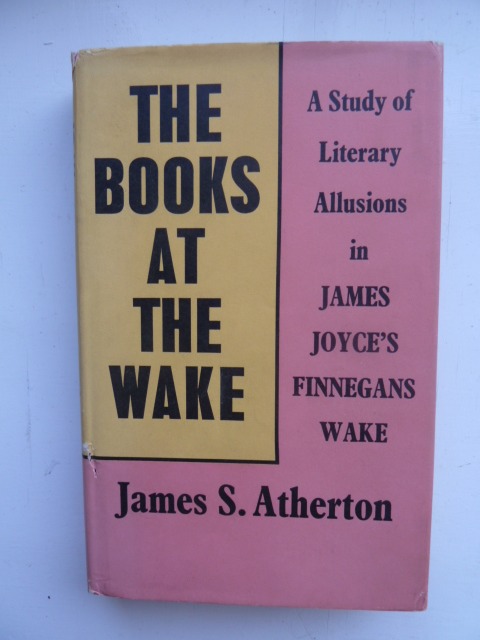
My own favourite is James Atherton's 'The Books at the Wake' (1959), which is a detailed study of the literary sources Joyce used. These include Skakespeare (every play is incorporated), Swift, Lewis Carroll, The Bible (every book) and the Koran (all 114 suras). But Joyce also built in references to his favourite books, such as Le Fanu's 'The House by the Churchyard' and Thomas Moore's 'Irish Melodies' (all first lines and titles of the melodies are used). Atherton lists several hundred separate works which can be found in the 'Wake', including the 11th edition of the 'Encyclopedia Brittanica', which Joyce plundered for river names and other geographical and historical references.


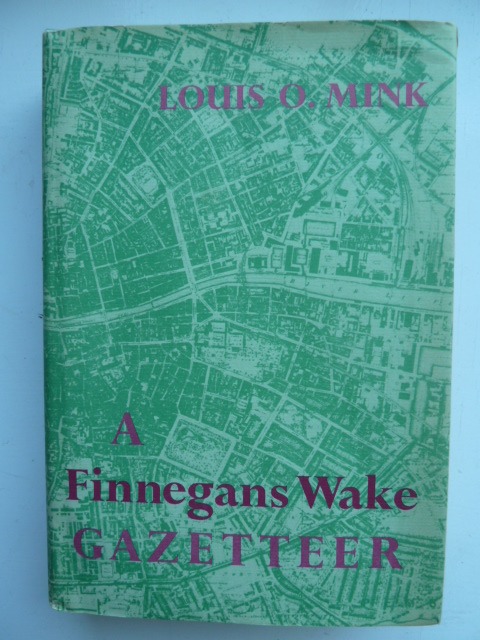
Louis Mink's 'A Finnegans Wake Gazetteer' (1978) includes references to the thousands of place name references, arranged both in linear form (i.e. in order of the text) and alphabetically.


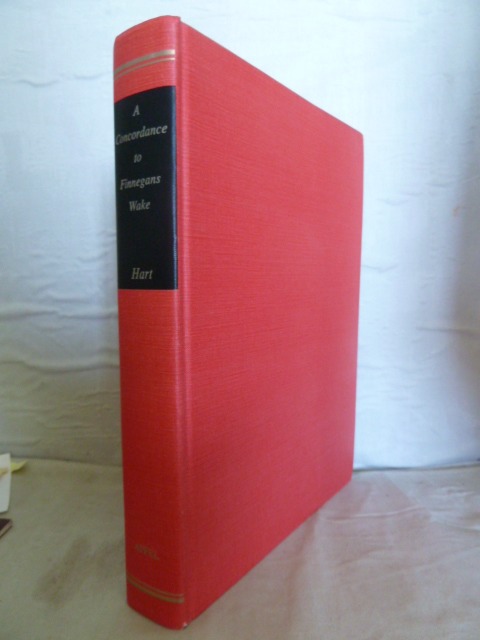
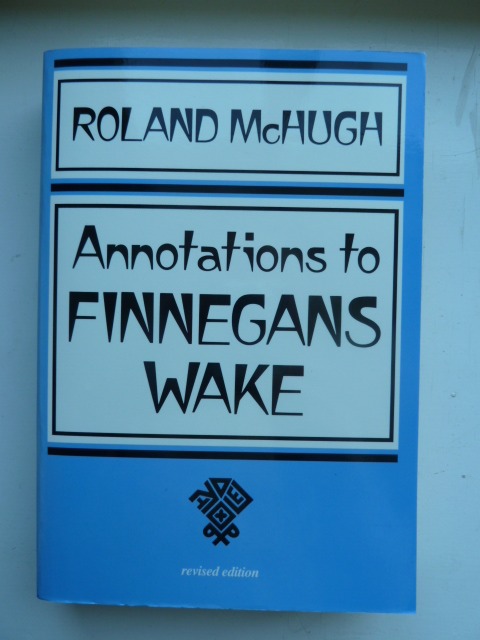
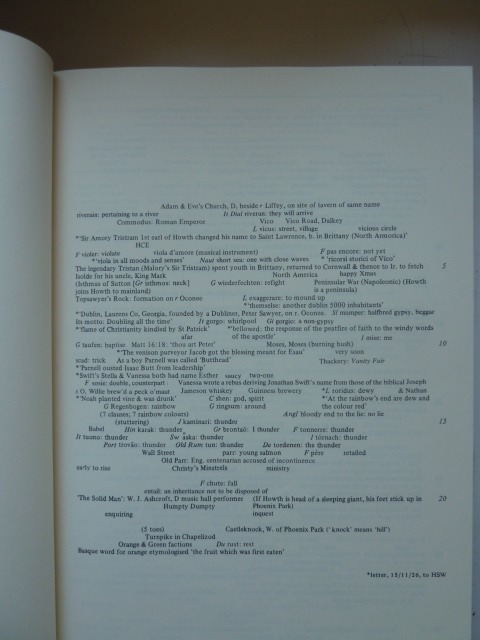
Add to these Clive Hart's massive 'Concordance' and McHugh's 'Annotations', which provides page by page analysis of every word requiring it, and you would be as well equipped as any previous reader.


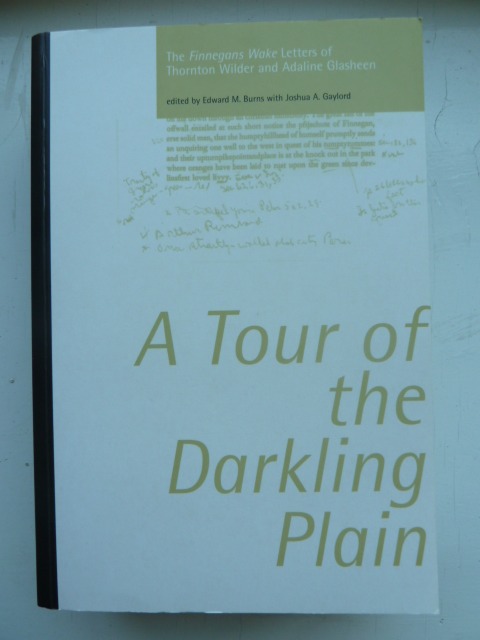
There is a wonderful book edited by Burns and Gaylord entitled 'A Tour of the Darkling Plain'.


This contains letters exchanged between Thornton Wilder and Adaline Glasheen over the period 1950 to 1975, in which they share their love of 'Finnegans Wake' and attempt to solve its mysteries. Glasheen went on to produce the wonderful 'A Census of Finnegans Wake' (1956), which lists the hundreds of characters, fictional and historical, who appear in the work, with suitable annotations. She later expanded this in second and third editions.

So, when to read 'Finnegans Wake'? Perhaps, as Joyce wrote it at the end of his writing life, it is best read late in your own reading life. It is the work of a mature mind at the very height of its powers.


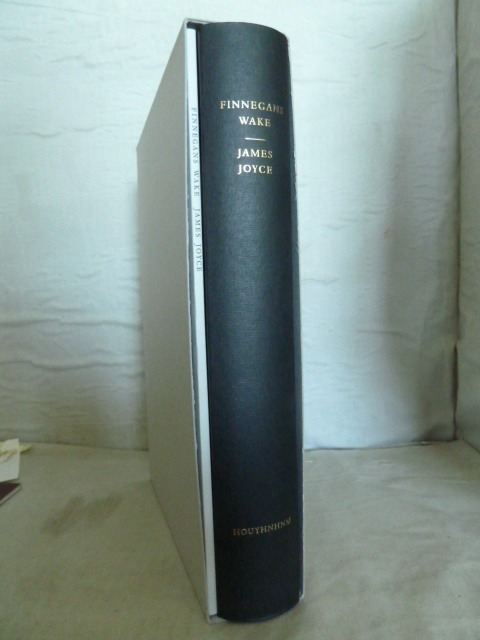
And perhaps now is exactly the right time, as a New Edition of 'Finnegans Wake', the product of many years work on the manuscripts, has just been published in a sumptuous edition by the Houyhnhnm Press, Dublin. This has some 9,000 'corrections' from the previously published version and is perhaps the last word on the text. It will be available in Penguin shortly.

Why read it? Because hidden away you will find (as on page 328, line 29), lines that take your breath away:

"In the buginning is the woid, in the muddle is the sounddance and thereinofter you're in the unbewised again, vund vulsyvolsy.".

For a succint statement of life (and death) that is about as good as literature can get.


- Posted using BlogPress from my iPad

Saturday, 20 August 2011

Joseph Sheridan Le Fanu, Dublin's Prince of Darkness


Those fortunate enough to have read the excellent anthology "Fifty Years of Ghost Stories" during childhood will have soon encountered two stories by J Sheridan Le Fanu, the man M R James considered the supreme writer of ghost stories - 'The Familiar' and 'Green Tea'. In the former, the unfortunate Captain Barton is pursued to his death in his own bedroom by a vengeful revenant; in the latter the Reverend Jennings is haunted by a monkey, the appearance of which is attributed to excessive consumption of green tea, and driven to suicide. Both are powerful stories and these alone would place Le Fanu high amongst writers of supernatural fiction.

However, add to these the unforgettable 'Carmilla', most frightening of all vampires, and 'Schalken the Painter', in which the terrified Rose Velderkaust, forced into marriage to a repulsive stranger by her uncle in return for a large dowry, returns from her wedding night to reveal she has been married to a dead man and Le Fanu is seen, as M R James noted, to be absolutely in the first rank of ghost story writers. I read most of these stories in 1960's in the Dover editions edited by E F Bleiler.


However, for those seeking Le Fanu's stories of the supernatural for the first time I would turn to the three volumes edited by Jim Rockhill and published by the Ash-Tree Press. In addition to forming a comprehensive set of the ghost stories, the Ash-Tree Press books are themselves beautifully produced and a delight to read and handle.


Le Fanu's powers as a ghost story writer reached their peak in "In a Glass Darkly", published in three volumes in 1872, the year before his death. This includes 'Green Tea', 'Carmilla' and, another of my favourites, 'Mr Justice Harbottle', in which a hanging judge is subjected to his own frightful supernatural judgement by one of his victims.


In addition to his short stories and minor writings Le Fanu wrote fourteen novels, the most celebrated being "Uncle Silas" and "The House by the Churchyard". As was customary for the time, the novels were generally first serialised in the popular magazines - "All the Year Round", "Dublin University Magazine", "Temple Bar".


"Uncle Silas" picks up a recurring theme in Le Fanu - vulnerable young women entrusted to the care of people who wish them harm by (not always) well-intentioned fathers, mothers or brothers. In "Uncle Silas", it is her dying father who, seeking to be reconciled with his estranged brother, passes Maud Ruthyn into the 'care' of her uncle, who plots her murder in order to inherit her fortune. In "Checkmate" it is Alice Arden's brother who attempts to force her into marriage with the villainous Mr. Longcluse. However, the ultimate betrayal is found in my personal favourite - "The Rose and the Key", in which it is her own mother who commits Maud Vernon to an asylum, again in pursuit of her daughter's fortune. The tension mounts remorselessly as Maud slowly realizes that the country house she thought she was visiting is, in fact, a lunatic asylum and sees her desperate attempts to escape taken as further proof of her madness.


The original three volume editions of the novels are now impossibly scarce and, commensurate with their rarity, very costly. I do have the first two volumes of "The Tenants of Malory" and that, I fear is as close as I will get.


However, single volume editions published later in the nineteenth century can be found and those published by Downey and Company form a particularly attractive set.


New editions of other novels also appear from time to time, sometimes under Irish press imprints.


A set of Collected Works in 51 volumes was produced by the Arno Press of New York in 1977, but to date I have only located two of the three volume novels, both ex University of Arizona.

Paperback editions of the more popular novels and short stories have been produced in recent years by, amongst others, Alan Sutton, Nonsuch Publishing and Wordsworth Editions.


"The House by the Churchyard" is justly famous, not only for its complex plot and wonderful evocation of Chapelizod, but also for the fact that the young James Joyce found a copy of the book in his father's library and later used elements of its plot and descriptions in "Finnegans Wake". In Le Fanu's work a crime is committed in Phoenix Park and this is mirrored in "Finnegans Wake" by Earwicker's encounter with the two women at the same location, which event brings about his fall and loss of reputation.

In addition, there are three references to "The House by the Churchyard" in the Wake that show how much Joyce admired Le Fanu's novel; these appear as 'Lefanu (Sheridan's) Old House by the Coachyard', 'The old house by the churpelizod' and (in Dutch) 'De oud huis bij de kerkegaard'. Having stood outside the house in Chapelizod, which was the inspiration for Le Fanu's work, on a cold grey December afternoon, I can well imagine what ghosts the building conjured up in the author's mind.


It was M R James in 1923, who cemented Le Fanu's reputation by his editorship of "Madame Crowl's Ghost and other Tales of Mystery", to which he added a useful prologue and an excellent bibliography. MRJ also contributed the introduction to the OUP World's Classics edition of "Uncle Silas". In recent years there has been a welcome increased interest in Le Fanu, spearheaded by Brian J Showers at the Swan River Press, Gary W Crawford via the on-line journal "Le Fanu Studies" and Jim Rockhill.

Le Fanu, the son of a Church of Ireland priest was born in 1814 in Dublin, where he spent much of his life - from 1856 to his death in 1873 living in No. 70 on the fashionable Merrion Square.


From 1861 he edited the Dublin University Magazine, in which many of his works first appeared and to which he began contributing in 1838, with the short story 'The Ghost and the Bonesetter'. Affected by the early death of his wife, Le Fanu was attracted to the writings of the Swedish philosopher Swedenborg, whose visions of Heaven and Hell may have influenced Le Fanu's work. Indeed, the popular image of the mature Le Fanu is of a tormented recluse emerging from his house on Merrion Square late at night to wander the streets of Dublin, pursued by the phantoms of his own nightmares. This does not quite square with the life of a busy editor and man of letters, but I do like to think that Le Fanu's ghost still paces the silent city streets deep into the night when all human traffic has ceased. And even in broad daylight, I have felt a shiver when walking along Aungier Street and remembering the 'strange disturbances' that afflicted a house on that Dublin street in Le Fanu's story.


- Posted using BlogPress from my iPad